Aetna's Policy Shift: How "Approved" Inpatient Claims Could Cost You Millions
The expansion of the Two-Midnight Rule into Medicare Advantage plans was supposed to be a win for hospitals. When CMS mandated (in 42 CFR 422.101) that MA plans follow the same inpatient admission criteria as traditional Medicare, revenue cycle leaders were cautiously optimistic. The rule promised to level the playing field: if the stay spans two midnights, or is expected to, it qualifies as inpatient.
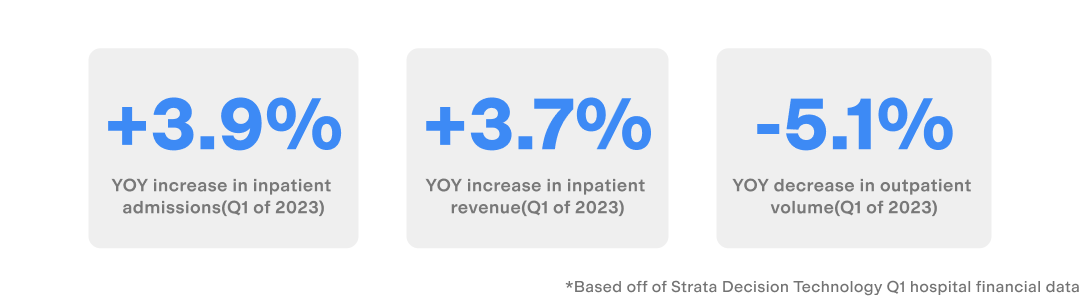
And for a brief moment, it worked. Inpatient admissions rose 3.9% year-over-year. Hospitals saw long-overdue reimbursement for the care they were already providing. Finance leaders across the country noted the shift. But now, Aetna may have found a way around it.
On November 15, 2025, Aetna automatically approved inpatient admissions for emergent or urgent Medicare Advantage cases that span at least one midnight. That might sound like progress: no more front-end denials and no more endless peer-to-peer calls.
But there's a catch: if the case doesn't meet the Milliman Care Guidelines (MCG) for inpatient criteria, it'll still be automatically approved, but only paid at observation-level rates.
And perhaps most importantly, there's no formal denial to appeal. No peer-to-peer. No notification. Just a payment quietly marked "complete" on your 835. The underpayment will simply appear on your remittance advice, and the billing system will treat the shortfall as a "contractual adjustment," as if the inpatient claim was fully reimbursed.
In other words, the revenue loss won't even trigger your standard denial workflows. It will silently undermine reimbursement without raising red flags.
Industry-Wide Implications: Masking Underpayment as Compliance
Aetna frames this as a move toward efficiency: avoiding delays, reducing provider burden, and removing the need to rebill as observation. But functionally, it enables plans to approve admissions while paying less, all while sidestepping the intent of the Two-Midnight Rule: protecting hospitals from inappropriate denials and revenue leakage.
This approach replaces transparency and due process with automation and opacity. It takes the fight out of the front end and buries the underpayment in your back-end reporting.
For finance and revenue leaders, this is a significant concern. The difference between full inpatient reimbursement and observation rates is not trivial. And when that gap is recorded as a contractual adjustment, it won't surface in typical denial or variance reporting. You'll only see it if you're actively reconciling expected versus actual payment at the claim level.
This concern is amplified by the broader financial pressures facing hospitals today. With many facilities at risk of closure or service reduction, payment policies that erode reimbursement for legitimate inpatient care could have far-reaching consequences, not just for revenue cycle performance, but for access to care and quality outcomes across the board.
The Financial Impact: What Revenue Cycle Leaders Need to Know
While this policy currently only applies to Aetna's Medicare Advantage and Special Needs Plans, if other MA plans adopt similar approaches, the impact will be felt nationwide, as 1.3% of inpatient revenue could vanish. Roughly 17% of MA inpatient claims are initially denied, and while 60% of those are currently overturned, that revenue will no longer be easily recovered. What was supposed to protect hospital reimbursement becomes a framework for systematic underpayment.
Key Financial Risks:
Flag high-risk claims: Modify billing systems to surface inpatient MA claims that are approved but paid at observation-level rates. These won't show up in typical denial workflows but must be treated as financial exceptions.
Strengthen documentation: Make sure providers and case managers understand MCG criteria and how to clearly document inpatient-level care. When appeals are no longer available, documentation becomes your only line of defense.
Review payer contracts: Understand your dispute rights and escalation paths under Aetna's policies. Prepare managed care and legal teams for payment challenges, not just denial rebuttals.
Monitoring and Analysis: Track the financial impact systematically to build a compelling case for policy reversal and to inform future contract negotiations.
Object directly to Aetna and CMS before this becomes precedent for other payers.
And most importantly, don't assume approved equals appropriate. The absence of a denial doesn't mean the payment is correct.
The Road Ahead: Preparing for Payment Model Evolution
This policy represents a significant shift in how MA plans may approach payment, even when following CMS regulations on admission criteria. The key to protecting revenue is proactive preparation.
This new payment approach doesn't come with a press release or a denial letter. It shows up quietly on your 835, marked "paid in full," but falling far short of what's owed. The time to prepare and protect your revenue is now, before this approach becomes widespread.
Success in this environment requires:
Vigilant monitoring of payment accuracy beyond traditional denial tracking
Exceptional documentation that proactively meets clinical criteria
Strong contract language protecting payment accuracy rights
Cross-functional collaboration between clinical, financial, and legal teams
Industry engagement to advocate for transparency and fair payment practices
The healthcare reimbursement landscape continues to evolve, and revenue cycle leaders must adapt their strategies to protect legitimate reimbursement while maintaining focus on patient care quality.
Why the next five years will separate the organizations that adopted AI tools from the organizations that transformed with AI, and how you can make sure you're on the right side of that line.
The moment we're in
Every few decades, a technology arrives that doesn't just make work faster, but it changes what an organization is. We saw it with electricity, we saw it with the internet, and it's happening again with agentic AI.
But here's what most coverage of AI in healthcare misses: the opportunity isn't a better tool for the people you already have. It's the ability to do more work and treat more patients without hiring more people, something every healthcare organization has been forced to accept as impossible for the last century.
Every organization in history has been built as a hierarchy, because hierarchies were the only way to move information: up from the front lines, decisions back down, coordination across teams. Layers of management exist not because anyone loves management layers, but because information doesn't move itself.
In healthcare, this has meant that administrators are bogged down with repetitive but high-value tasks that are ultimately a drag on the US economy.
We finally have technology that can act as the glue. Modern AI agents can carry information up and down an organization, coordinate work across functions, and execute the administrative tasks that hierarchy was built to manage. What's on the table isn't chatbots living in the corner of a workflow. It's the chance to change the operating structure of the enterprise itself.
Which raises a question worth sitting with before you evaluate another vendor. If the hierarchy you inherited was optional, what would you do differently? This post is what that means for healthcare, why the economics make this inevitable, and how you can take your organization to the promised land.
The economics of healthcare's broken production curve
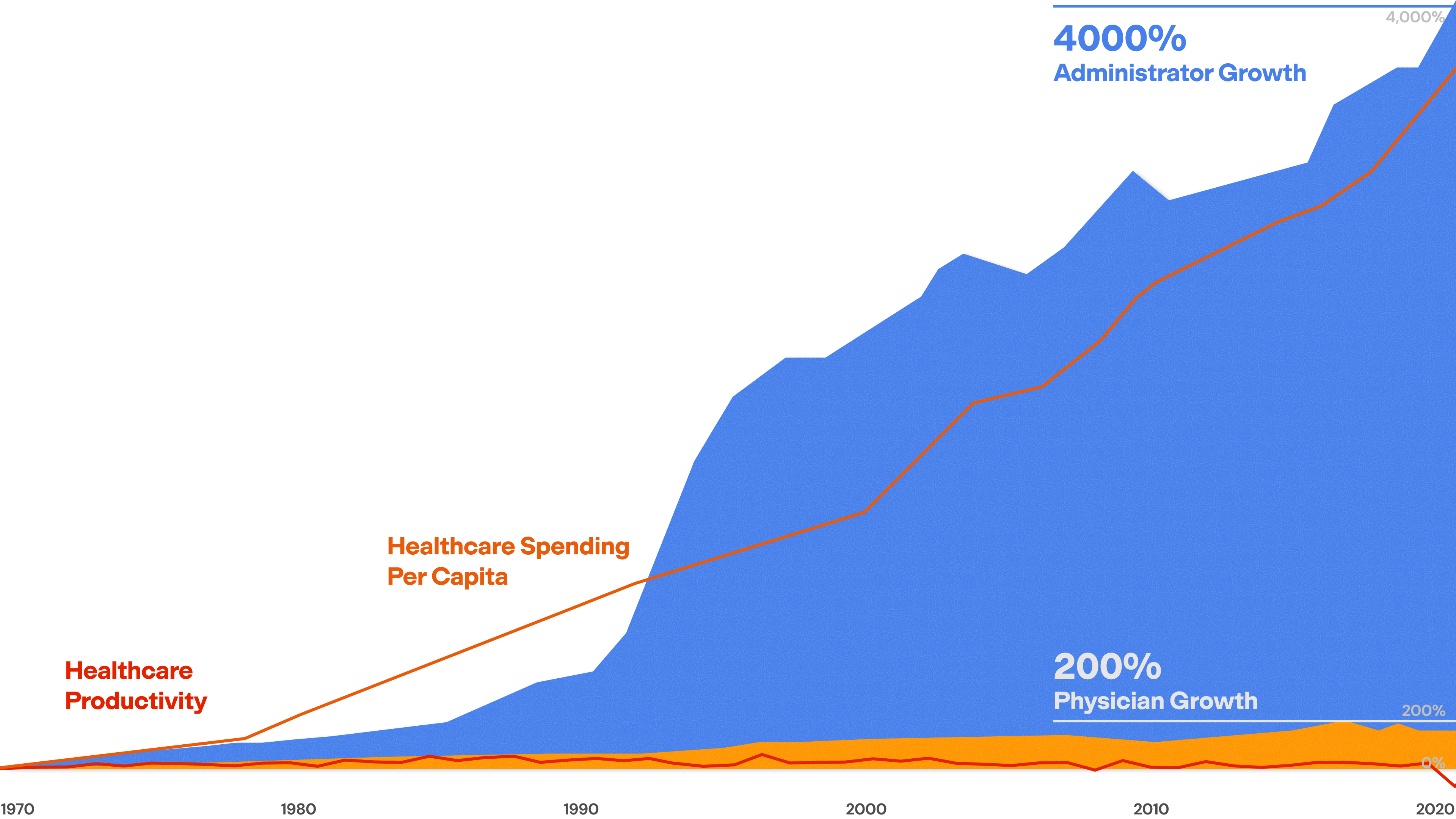
Over the last fifty years, the number of physicians in the U.S. grew roughly 200%, while the number of administrators grew roughly 4,000%, all while per-capita healthcare spending grew roughly 2,000% and productivity stayed flat.
The capacity to deliver care grew arithmetically while the administrative apparatus around it grew exponentially. Yet the production curve, the relationship between clinician capacity and the number of patients served, grew linearly because productivity stayed flat. Every additional patient has required additional people, and nothing has ever relieved that pressure.
Economists have a name for this trap: Baumol's cost disease. Labor-intensive sectors like healthcare struggle to capture the productivity gains that transformed other industries like manufacturing and software, and as a result, their costs rise relentlessly relative to everything else. Healthcare administration is the purest case of this in the American economy. The work behind the scenes to deliver care, such as prior authorizations, billing, denials, eligibility, scheduling, coding, and follow-ups, is an extreme pattern of this coordination work done by people at a scale that compounds each year.
So far, software has had no impact on fixing this. EHRs digitized paperwork, and while they improved patient outcomes by making information readily available, they didn't reduce the number of people required to push that paperwork. RPA also fell short of its promises, with brittle bots automating keystrokes while the coordination burden kept growing around the people it tried to automate.
Agentic AI is the first technology with the promise to bend this curve, because it doesn't just speed up a task inside the structure. It can replace the coordination function the structure exists to perform. That is the difference between a 5% efficiency gain and a different cost basis for running a healthcare organization.
"5% more efficient at a process that shouldn't exist is still 95% inefficient."
The organizations that internalize this first won't just have a lower cost-to-collect. They will operate on a fundamentally different production curve than their peers, generating more revenue per FTE, getting cash in the door faster, and scaling administrative capacity without scaling headcount. These organizations could absorb growth without absorbing cost rather than having to choose between the two.
The path most organizations never explore
Every health system pursuing AI today is on one of two paths, whether they've named it or not.
Path one is tool adoption. You buy AI features, give copilots to staff inside the existing hierarchy, and every person gets a little faster but the structure stays exactly the same. This is a safe path, and it produces comfortable results with single-digit efficiency gains that disappear into the noise of a budget cycle. Tool adoption automates down, taking the tasks at the bottom of the pyramid and shaving a few minutes off each one.
Path two is transformation. Enterprises can redesign their operations around what AI can now own. Agents run entire workflows end to end, so humans move to the edge of the process and do the things only they can do: judgment calls, exceptions, building relationships, and delivering care. The coordination that required layers of management becomes intelligence built into the system, and the multiple levels of hierarchy collapse into two.
We think of this as automating up, not down. It's the difference between an AI initiative that shows up on a board slide and one that shows up in your financials.
The 5 levels of healthcare automation
Transformation is meant to be a climb, not a leap. We map every organization we work with against five levels. Finding yours is the first honest step.
Level 1, Rules and robots. Leveraging macros, scripts, and RPA bots that follow explicit instructions on structured inputs. Useful, but brittle and expensive to maintain as every payer portal change breaks something. Most health systems have been here for a decade, and the ceiling is that rules can't handle the ambiguity that makes up most administrative work.
Level 2, Assistive AI. Software with AI features built in. Copilots draft appeal letters, summarize accounts, and suggest codes. Individual staff get faster, but every workflow still routes through a human, and the org chart is untouched. This is where much of the industry sits today and where tool adoption stalls. The ceiling here is that you've made each seat more productive without needing more seats. Your capacity is still bounded by the number of people you have, which means the only way to grow is still to hire.
Level 3, Autonomous workflows. Agents own discrete, well-defined workflows end to end, with humans reviewing by exception rather than by default. This is the first level where the production curve visibly moves, because work completes without a person in the loop. The ceiling is that these workflows are automated in silos, so the coordination between them is still entirely human.
Level 4, Coordinated agent operations. Fleets of agents that work across functions, hand off to each other, escalate intelligently, and are managed the way you'd manage a team, with performance visibility, quality controls, and clear ownership. Supervisors oversee agent capacity the way they once oversaw human capacity, and the organization can restructure around this so there are fewer coordination roles, and more exception-and-judgment roles.
Level 5, The agentic organization. Intelligence is the coordination layer, so information moves through the system without hierarchy moving it. Humans sit at the edge as clinicians, decision-makers, relationship owners, and administrative capacity scales with compute instead of headcount. The production curve is no longer linear. This is the destination, and no one in healthcare is fully there yet. The market leaders will be within the decade.
Two things are true about this pyramid. First, you can't skip levels. An organization that has never trusted an agent with a workflow can't leap to coordinated fleets. Second, the value is wildly non-linear. Levels 1 and 2 are measured in minutes saved. Levels 3 through 5 are measured in the shape of your labor cost structure.
Why you can't shortcut your way up the pyramid
Here's the uncomfortable truth about why so many AI initiatives in healthcare quietly stall at level 2: transformation is not a procurement decision.
Software vendors sell you a tool and a login, but the climb from level 2 to level 4 runs through the messiest parts of an enterprise across legacy systems, undocumented processes, payer idiosyncrasies, staff who have every reason to be skeptical, and workflows that exist only in the heads of the people running them. There isn't a tool out there that can absorb these headwinds on its own.
Someone has to do the hard work of transformation: map the process, deploy against your actual systems, and earn trust one workflow and one team at a time. Then redesign the roles as agents take on more.
Trust is the hardest part of that work, and it should be. Handing a workflow to an agent in healthcare carries real exposure: audit risk, compliance obligations, and payer relationships that a single bad automated touch can damage. Leaders who slow down here aren't being change-averse, they're being responsible. But this is also why the climb can't be skipped. Agents earn autonomy the way a new employee does, by starting under full review and expanding scope only as accuracy holds.
The model that works, in healthcare and any other industry undergoing this shift, pairs the technology with the people deploying it. What you should be looking to buy isn't software, but rather outcomes delivered by a team you hold accountable for making the transformation real inside your organization, on your systems, with your people. The technology matters enormously, but the technology alone cannot transform your organization.
Where the climb starts
Transformation carries the connotation of a multi-year odyssey. In practice it starts far smaller: one workflow with a clear financial signature, a measurable baseline, deployment against production systems with humans reviewing everything, and a deliberate redesign of the roles it touches.
Each pattern compounds. Each workflow makes the next one faster to deploy. Each accurate run earns the agent more autonomy. And somewhere along the way, the conversation shifts from "should we automate this task" to "what should this department look like."
What is at stake
American healthcare spends on the order of $1.5 trillion a year on administration to do coordination work that agentic AI can increasingly perform. That money isn't abstract, it's the gap between what care costs and what care should cost for every American, whether they're a patient or an employer.
For your organization, the stake is more immediate. Bending this curve is the difference between an organization that can grow without growing its administrative cost base and one that will keep paying more every year for the same output, against competitors who no longer have to.
This transformation won't be accomplished by giving every administrator a copilot, but it will be accomplished by leaders willing to ask the rebuild question honestly: what would this organization look like if we rebuilt it today? And then to climb, level by level, until the answer and the reality converge.
The technology is ready. The economics are undeniable. The only variable left is which organizations move first.
Hospitals lose $19.7B annually fighting denials, yet 54% get overturned on appeal. This guide shows how AI automation reduces appeal time from 4 hours to 15 minutes while increasing success rates. Start reclaiming your revenue today.
Nearly 15% of all medical claims submitted to private payers and approximately 16% of Medicare Advantage claims were initially denied in 2024, with inpatient care facing an even higher denial rate of 14.07% (Premier Inc., 2024). This concerning trend creates significant financial strain for healthcare providers, with hospitals spending an estimated $19.7 billion annually fighting denied claims. What's more alarming is that more than half of denied claims (54.3%) are eventually overturned after costly appeals processes, indicating many denials should never have happened in the first place.
As inpatient care represents some of the most complex and highest-value claims in healthcare, mastering the appeals process has become essential for protecting revenue integrity. This guide provides hospital administrators and revenue cycle teams with practical strategies to optimize inpatient appeals submission, reduce administrative burdens, and maximize successful outcomes.
Why Inpatient Appeals Are So Challenging
Why Inpatient Documentation Gets Denied
Inpatient claims involve intricate coding requirements, extensive documentation, and complex medical decision-making that must be clearly communicated to payers. Documentation must effectively demonstrate medical necessity for the admission, appropriate level of care, accurate DRG assignment, and clinical validation of diagnoses. With 46% of providers identifying missing or inaccurate information as the primary cause for claim denials (Experian Health, 2024), ensuring comprehensive documentation is critical.
The Unsustainable Administrative Burden
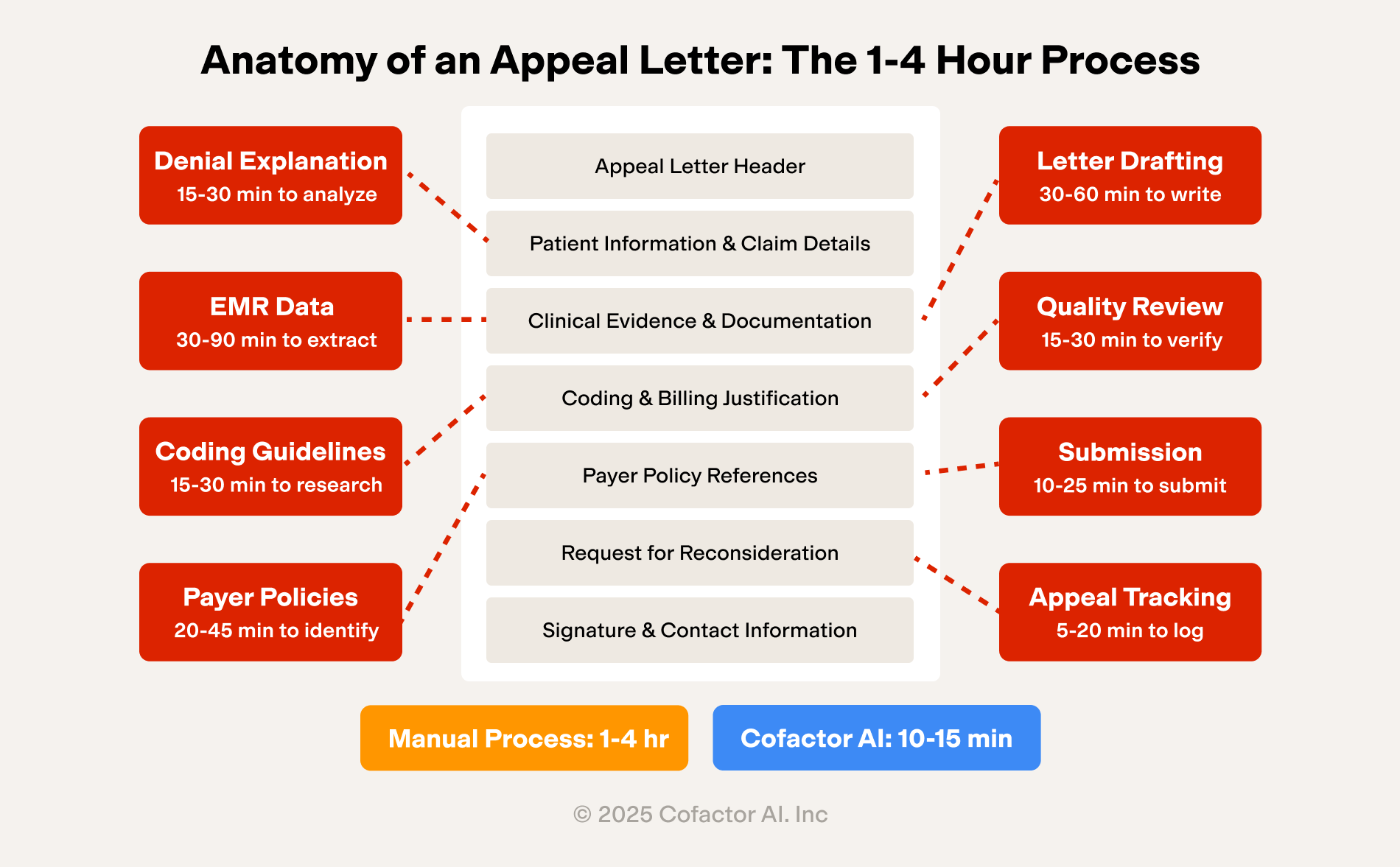
The traditional appeals process is highly manual and time-intensive. A typical denial appeal requires a clinical professional to:
Review the denial reason
Access and analyze relevant medical records
Identify supporting clinical evidence
Research applicable coding guidelines and payer policies
Draft a persuasive appeal letter
Submit the appeal through the appropriate channels
Track the appeal status
Follow up as needed
With revenue cycle teams already stretched thin due to staffing shortages affecting 83% of healthcare organizations (American College of Healthcare Executives, 2024), the growing volume of denials creates an unsustainable workload.
Navigating Payer-Specific Requirements
Each payer has unique submission requirements, deadlines, and appeal processes that must be carefully navigated. Missing a deadline or failing to include required documentation can result in automatic rejection of the appeal, regardless of its merit.
Track These 5 Essential Appeal Metrics
Initial Denial Rate (IDR): Measures the percentage of claims denied upon first submission. The industry average for inpatient claims is approximately 14%, but high-performing organizations aim for single digits.
Appeal Success Rate: Tracks the percentage of appealed denials that result in payment. Organizations should aim for success rates above 60%, with many achieving 70–80% for properly selected and executed appeals.
Appeal Submission Rate: Measures what percentage of eligible denials actually get appealed. Due to resource constraints, many organizations appeal less than 50% of denied claims, leaving significant revenue uncollected.
Days in Accounts Receivable (A/R): Appeals significantly extend the revenue cycle. The average time to resolve an appealed claim is 45–90 days, with some complex cases extending beyond 120 days.
Cost to Appeal: The average cost to appeal a denied claim is approximately $44 per appeal, not including clinical labor costs which can add $13–51 per claim depending on complexity (Premier Inc., May 2024).
Effective Strategies for Inpatient Appeals Submission
1. Strategic Denial Prioritization
Not all denials are created equal. Prioritize appeals based on:
Financial impact: Focus resources on high-dollar claims first
Probability of success: Analyze historical overturn rates by denial type and payer
Appeal deadline: Ensure timely submission for all appeals
Root cause analysis: Identify and address systematic issues to prevent future denials
Create a scoring system that incorporates these factors to objectively rank denials requiring appeals.
2. Build Denial-Proof Documentation
Successful appeals require thorough analysis of the medical record to identify evidence supporting the claim:
Review physician notes, nursing documentation, lab results, and all clinical assessments
Extract specific clinical indicators supporting medical necessity
Identify documentation of the patient's condition that justifies the level of care provided
Cross-reference clinical evidence with payer medical policies
Ensure the appeal directly addresses the specific reason for denial with relevant clinical evidence.
3. Write Appeals That Get Overturned
The appeal letter is your opportunity to present a compelling case for payment. Effective appeal letters should:
Clearly state the purpose of the letter and claim information
Reference the specific denial reason and code
Present a concise, evidence-based argument addressing the denial reason
Include supporting clinical evidence with specific references to the medical record
Cite relevant clinical guidelines, coding standards, or payer policies that support your position
Request specific action (e.g., claim payment, peer-to-peer review)
Always maintain a professional, fact-based tone rather than an emotional or confrontational approach.
4. Optimize Your Team Structure
Create specialized appeals teams with the right mix of clinical and revenue cycle expertise:
Clinical specialists: Typically nurses or physicians who can interpret medical documentation and identify relevant clinical evidence
Coding experts: Professionals who understand coding guidelines and can address coding-related denials
Appeals coordinators: Team members who manage the administrative aspects of the appeals process
Payer specialists: Staff members who develop expertise with specific payers' requirements and processes
This specialized approach allows team members to develop deep expertise in their area of focus.
5. Leveraging Technology Solutions
Modern technology can significantly enhance the efficiency and effectiveness of the appeals process:
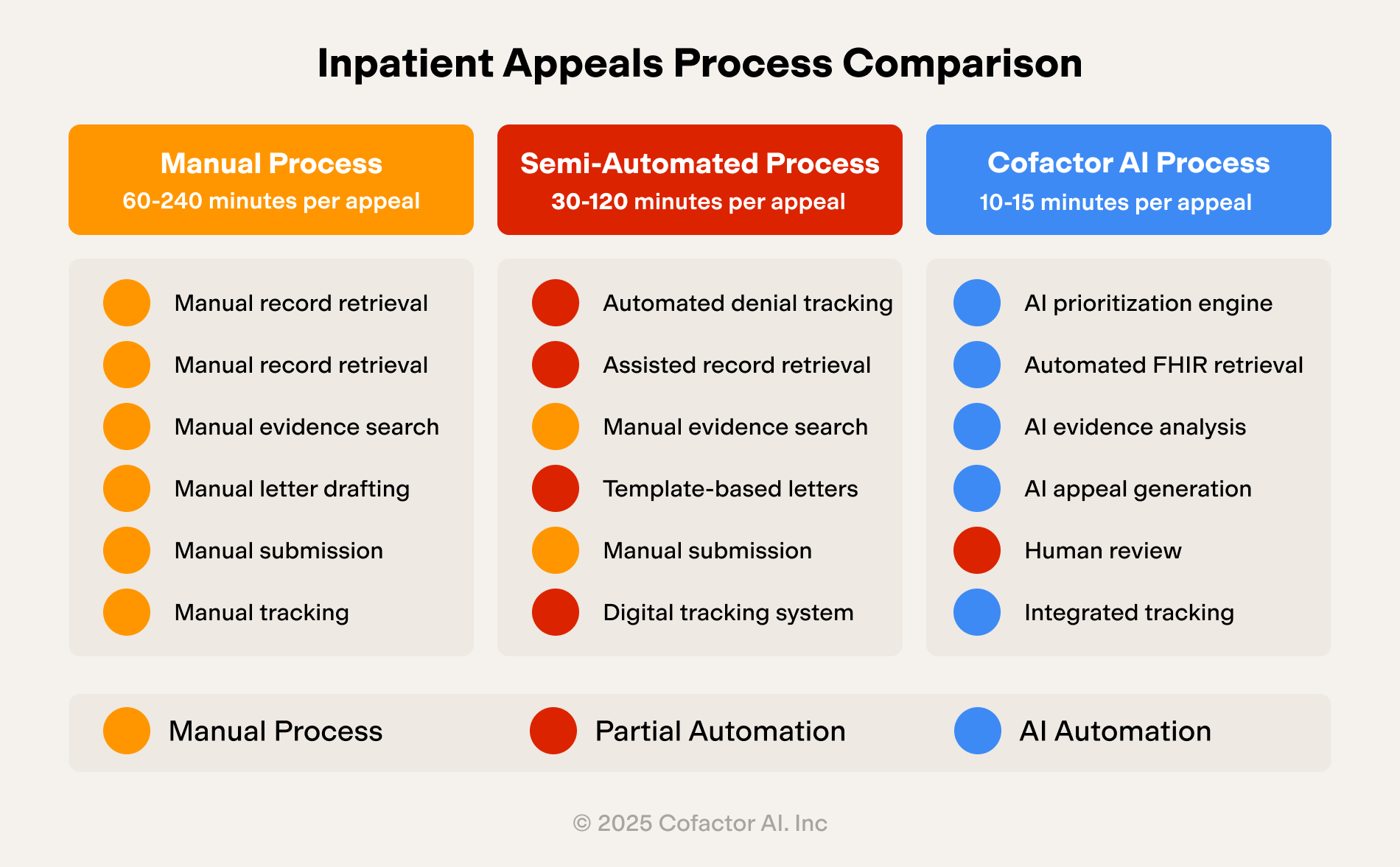
Manual Appeals Process
The traditional manual appeals process typically follows these steps:
Automated denial identification: Systems flag denied claims for review
Prioritization tools: Software helps rank denials based on value and appeal potential
Template libraries: Pre-built letter templates specific to denial types
Workflow management: Systems track appeals through the process
Reporting tools: Analytics provide insights into appeal outcomes and trends
While more efficient than fully manual processes, semi-automated solutions still require significant manual effort for evidence identification and letter customization.
The Future of Inpatient Appeals: AI-Driven Automation
The most advanced approach utilizes AI for intelligent denial prioritization (analyzing patterns and financial impact to recommend which claims to appeal), automated medical record analysis (reviewing The most advanced approach utilizes artificial intelligence to transform the appeals process through:
Intelligent denial prioritization: AI analyzes denial patterns, historical success rates, and financial impact to recommend which claims to appeal
Automated medical record analysis: AI reviews clinical documentation to identify relevant evidence supporting the appeal
Evidence matching: AI links clinical evidence to specific payer requirements and medical policies
Appeal letter generation: AI creates customized, evidence-based appeal letters tailored to the specific denial reason
Continuous improvement: The system learns from outcomes to improve future appeal strategies
This approach can reduce the time spent on appeals by 80-90%, allowing organizations to appeal a higher percentage of denials while freeing clinical staff to focus on patient care.
How Cofactor Transforms the Inpatient Appeals Process
Intelligent Prioritization: Cofactor analyzes each denial's financial impact, appeal deadline, probability of success, and historical patterns to ensure your team focuses resources on appeals with the highest potential return.
Automated Evidence Identification: Our AI analyzes the complete medical record through FHIR integration with your EMR, extracting relevant clinical indicators, connecting evidence to specific denial reasons, and compiling evidence from throughout the record, even when it appears in unexpected locations.
Comprehensive Appeal Generation: Cofactor generates complete appeal letters addressing the specific denial reason with relevant clinical evidence, appropriate references to guidelines and policies, and a clear, professional argument, produced in minutes rather than hours.
Human Review and Submission: While Cofactor automates the most time-intensive components, it maintains a human-in-the-loop approach where all appeals undergo final review before submission, ensuring quality control and appropriate submission through your established channels. This transforms what typically takes 1–4 hours per appeal into a process requiring just 10–15 minutes of staff time.
Current Trends in Inpatient Appeals Management
1. Rising Complexity of Denials
Payers are increasingly employing sophisticated strategies to deny claims, including:
More rigorous clinical validation requirements
Stricter interpretation of medical necessity criteria
Increased scrutiny of DRG assignments
More frequent requests for additional documentation
This trend requires equally sophisticated appeal strategies that directly address these complex denial reasons.
2. Growth of Artificial Intelligence Solutions
Healthcare organizations are rapidly adopting AI tools to address the growing administrative burden. According to a recent survey from Healthcare IT News, organizations using AI for appeals are now able to process denials three times faster than manual methods, allowing clinical staff to focus on patient care rather than paperwork.
These tools can analyze vast amounts of clinical documentation, identify relevant evidence, and generate compelling appeal letters in a fraction of the time required by manual processes.
3. Shift from Reactive to Preventative Approaches
Forward-thinking organizations are moving beyond simply reacting to denials to implementing preventative strategies. By analyzing patterns in successful appeals, they identify root causes of denials and implement process improvements to prevent future occurrences.
4. Increased Collaboration Between Clinical and Revenue Cycle Teams
Effective appeals require seamless collaboration between clinical experts who understand medical documentation and revenue cycle professionals who understand payer requirements. Organizations are breaking down silos between these departments to create integrated appeals teams.
Transform Your Inpatient Appeals Process Today
The financial impact of inpatient claim denials cannot be overstated. With denial rates at historic highs and more than half of denied claims ultimately being paid upon appeal, an effective appeals strategy is essential for financial sustainability.
By implementing the strategies outlined in this guide and leveraging advanced technology solutions, healthcare organizations can reduce administrative burden, increase appeal capacity without adding staff, improve appeal success rates, shorten the revenue cycle, and generate valuable insights to prevent future denials.
The most successful organizations view denial management not as a cost center but as an opportunity to protect revenue integrity and improve financial performance.
Recent data from the American Hospital Association reveals that between 2022 and 2023, Medicare Advantage claim denials increased by a staggering 55.7%, representing billions in contested revenue for U.S. hospitals (AHA, September 2024). With hospital operating margins hovering at just 2.5%, DRG downgrades represent a significant threat to financial sustainability. This guide provides hospital administrators with a practical, step-by-step approach to identify, prevent, and combat DRG downgrades using artificial intelligence and strategic operational improvements.
Understanding DRG Downgrades: The Silent Revenue Drain
Diagnosis-Related Group (DRG) downgrades occur when payers retrospectively review inpatient claims and determine that a lower-weighted DRG should have been assigned, resulting in reduced reimbursement. Unlike outright denials, these often appear as post-payment adjustments, making them particularly insidious, your hospital may not realize revenue is being reclaimed until it's too late.
Key DRG Downgrade Metrics Every Administrator Should Track
Downgrade Rate: Percentage of inpatient claims that receive DRG downgrades
According to data from Ballad Health shared by Ascendient Healthcare Advisors, up to 10% of inpatient discharges are affected by "level of care changes" including DRG downgrades (Ascendient, 2023).
Financial Impact Rate: Average dollar value lost per downgraded claim
Downgrading a pneumonia with sepsis case to simple pneumonia can result in payment reductions of approximately $5,316 per case (Ascendient, 2023).
Sound Physicians reports that overturning a sepsis diagnosis downgrade to a localized infection can recover between $3,000 and $7,000 per claim (Sound Physicians, November 2024).
Recovery Rate: Percentage of downgrades successfully overturned through appeals
A 2024 survey by Premier Inc. found that 54% of private payer denials are eventually overturned, though often only after multiple costly appeal attempts (Premier Inc., 2024).
Different payer types show varying overturn rates: private commercial payers overturn over 60% of initial denials, Medicare and Managed Medicaid overturn about 50%, and traditional Medicaid overturn about 46% (TechTarget, 2024).
Administrative Cost: Cost to process each appeal
A recent healthcare industry analysis reveals that providers spend nearly $44 on each appeal, which equates to almost $20 billion annually across the healthcare system (AHA, April 2024).
Secondary Impact: Long-term effects beyond the immediate financial loss
Repeated DRG downgrades can lower a hospital's case mix index (CMI), which is used in setting prospective payments and can reduce reimbursement levels for years to come (Ascendient, 2023).
Common Types of DRG Downgrades and Their Prevalence
Understanding the most frequent downgrade scenarios helps focus prevention efforts:
Clinical Validation Downgrades These occur when payers challenge the clinical evidence supporting specific diagnoses. According to recent healthcare data, the most frequently targeted conditions include sepsis, acute respiratory failure (J96), acute kidney injury (N17), severe malnutrition (E43), and type 2 myocardial infarction (I21.A1) (The Hospitalist, September 2024). These diagnoses significantly impact DRG weights and are often subject to differing clinical criteria interpretations between providers and payers.
Principal Diagnosis Resequencing Payers rearrange the sequencing of diagnoses to achieve a lower-weighted DRG, often claiming the documented principal diagnosis was a symptom rather than the underlying condition. For example, a patient admitted with both sepsis and pneumonia may have the pneumonia recategorized as the principal diagnosis, resulting in a significant payment reduction.
Severity of Illness Downgrades Challenges to complication and comorbidity (CC) or major complication and comorbidity (MCC) classifications that reduce the severity level and corresponding payment. According to CMS data, the presence of an MCC in a case is a stronger indicator of resource use than the specific principal diagnosis or procedure (NCBI, 2020), making these high-value targets for payer scrutiny.
Insufficient Documentation Downgrades Claims where documentation lacks specificity or fails to support the medical necessity for the inpatient level of care. Sound Physicians notes that secondary diagnoses with only one documented complication or comorbidity are particularly vulnerable to downgrades (Sound Physicians, November 2024).
Leveraging AI for DRG Downgrade Prevention and Response
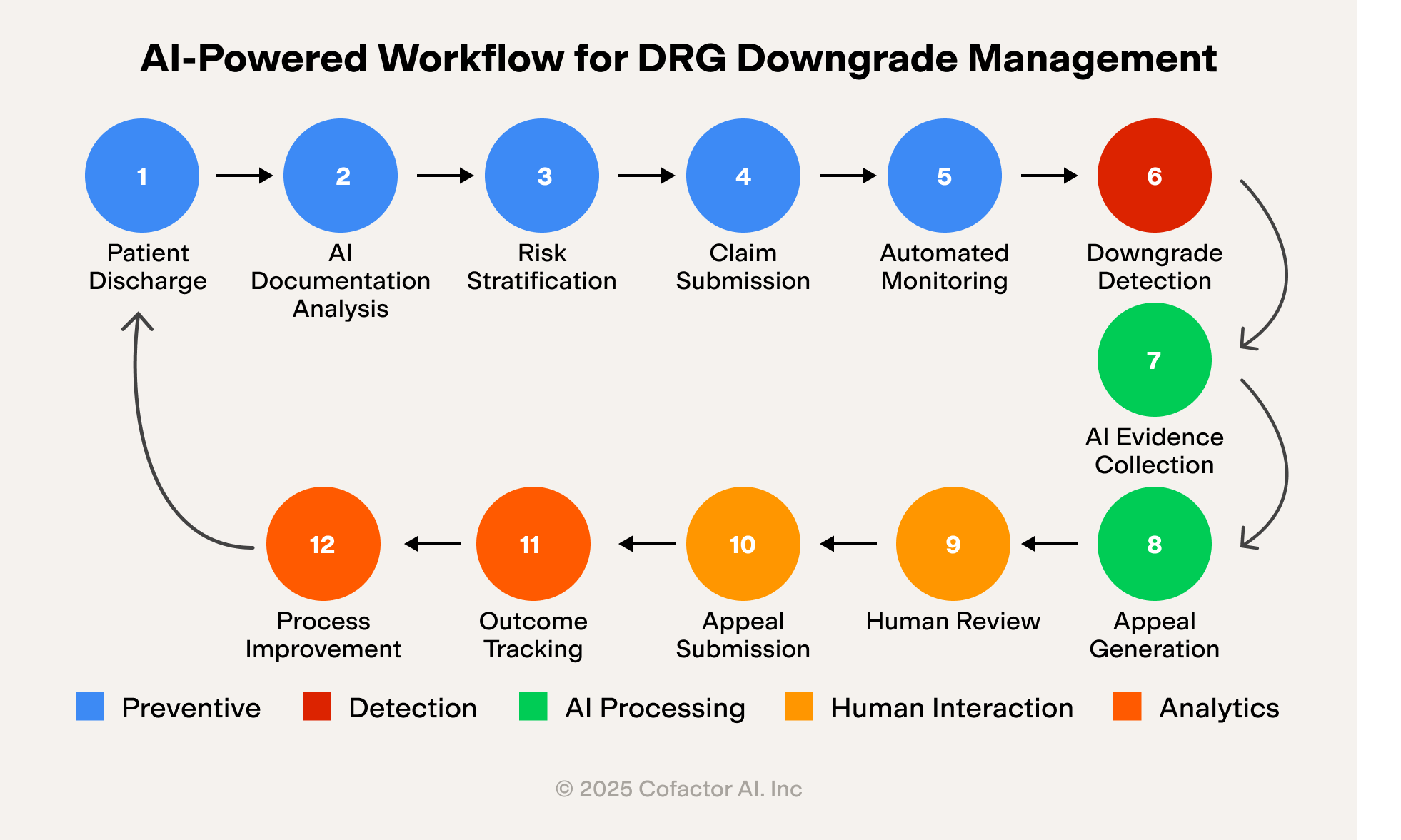
1. Predictive Analysis and Risk Stratification
Deploy AI to analyze historical downgrade patterns by payer, service line, and DRG, develop risk scores for current inpatient stays, and create real-time alerts for high-risk cases before claim submission. Hospital systems implementing predictive analytics can identify which cases are at highest risk, allowing CDI specialists to focus resources before submission.
2. Documentation Gap Analysis
Use natural language processing to analyze clinical notes against coding requirements, identify documentation patterns that frequently lead to downgrades, and generate physician-specific education opportunities. AI systems can scan thousands of records in minutes to flag potential documentation gaps before submission.
3. Automated Evidence Collection for Appeals
Implement AI that can rapidly search the entire medical record for clinical evidence, automatically extract relevant documentation for appeals, and prioritize appeals based on likelihood of success and financial impact. Leading health systems are using AI to automate appeals for bulk denials from a single payer, allowing staff to focus on cases with the highest potential return.
4. Payer Behavior Pattern Recognition
Use AI analytics to identify payer-specific denial patterns, develop targeted documentation strategies for high-risk DRGs by payer, and establish benchmark metrics to identify anomalous behavior. Analysis might reveal that certain payers consistently challenge specific diagnoses, allowing hospitals to strengthen documentation for those conditions in advance.
Optimizing Team Structure and Workflows
Build a cross-functional downgrade defense team including dedicated clinical documentation specialists with DRG expertise, physician advisors with specialty-specific knowledge, certified coders, revenue cycle specialists focused on payer policies, and data analysts to monitor trends. Hold weekly case review meetings, establish clear escalation paths for physician queries, and develop payer-specific response protocols.
Key workflow integration points include pre-discharge documentation checkpoints for high-risk DRGs, coding validation review for AI-flagged cases, post-discharge query opportunities before claim submission, and post-payment review triggering automated evidence collection. Some providers tag accounts with heavily scrutinized diagnosis codes for review before billing to catch issues before submission.
Staff Education and Training Approaches
For physicians: specialty-specific documentation requirements, interactive case studies showing documentation gaps, and quick reference guides for commonly challenged diagnoses. For CDI specialists: advanced training on payer-specific clinical validation criteria and query development skills. For coders: advanced DRG optimization within compliance guidelines and payer-specific coding guidance.
Use AI to analyze downgrade patterns by physician, service line, and diagnosis to develop targeted, data-driven education. Some organizations have CDI specialists attend monthly physician staff meetings to explain where inappropriate downgrades occur and share prevention strategies.
Current Industry Trends in DRG Downgrade Management
The most forward-thinking organizations are shifting from reactive appeals to proactive validation, implementing AI-powered pre-bill reviews that catch documentation gaps before claims are processed. Advanced health systems are developing payer-specific documentation templates guided by AI analysis of historical patterns. Several health systems have formed collaborative networks to share anonymized downgrade data, helping identify emerging payer tactics across organizations. The most significant advancement is AI systems that can automatically generate comprehensive appeal letters, reducing appeal creation time from hours to minutes while increasing success rates.
How Cofactor Transforms DRG Downgrade Management
Cofactor's AI analyzes the complete medical record to identify all relevant clinical evidence supporting the originally coded DRG, automatically compiling it into a comprehensive appeal letter and transforming what typically takes 1–4 hours per case into a 10–15 minute review process.
Our system continuously analyzes patterns in payer behavior, identifying emerging downgrade trends before they become widespread, allowing targeted documentation improvements that protect revenue before downgrades occur. Hospitals using Cofactor's predictive analytics have reduced downgrade rates by up to 30% for high-risk DRGs.
Cofactor integrates with your existing EMR and clearinghouse systems, automatically prioritizing downgrade cases based on financial impact, appeal deadline, and likelihood of success. Hospitals implementing Cofactor's technology typically experience an 80–90% reduction in time spent creating downgrade appeals, the ability to process 3–4 times more appeals with existing staff, and substantial ROI in cost-to-appeal savings.
Conclusion
DRG downgrades represent a significant but often underaddressed threat to hospital financial performance. By implementing AI-powered solutions, healthcare organizations can dramatically improve their ability to identify, prevent, and combat these revenue challenges. The result is not only improved financial performance but also reduced administrative burden, allowing clinical and revenue cycle staff to focus on their core mission of providing exceptional patient care.
Thank you! Your submission has been received!
Oops! Something went wrong while submitting the form.
Replacing healthcare's administrative complexity with intelligence. Based in Chicago, IL.


.svg)