We couldn't find a match for your search.

Healthcare spends $1.5 trillion a year on administration. AI can finally bend that curve, but only for the organizations willing to actually transform, not just adopt another tool.
X min read
Why the next five years will separate the organizations that adopted AI tools from the organizations that transformed with AI, and how you can make sure you're on the right side of that line.
Every few decades, a technology arrives that doesn't just make work faster, but it changes what an organization is. We saw it with electricity, we saw it with the internet, and it's happening again with agentic AI.
But here's what most coverage of AI in healthcare misses: the opportunity isn't a better tool for the people you already have. It's the ability to do more work and treat more patients without hiring more people, something every healthcare organization has been forced to accept as impossible for the last century.
Every organization in history has been built as a hierarchy, because hierarchies were the only way to move information: up from the front lines, decisions back down, coordination across teams. Layers of management exist not because anyone loves management layers, but because information doesn't move itself.
In healthcare, this has meant that administrators are bogged down with repetitive but high-value tasks that are ultimately a drag on the US economy.
We finally have technology that can act as the glue. Modern AI agents can carry information up and down an organization, coordinate work across functions, and execute the administrative tasks that hierarchy was built to manage. What's on the table isn't chatbots living in the corner of a workflow. It's the chance to change the operating structure of the enterprise itself.
Which raises a question worth sitting with before you evaluate another vendor. If the hierarchy you inherited was optional, what would you do differently? This post is what that means for healthcare, why the economics make this inevitable, and how you can take your organization to the promised land.
Over the last fifty years, the number of physicians in the U.S. grew roughly 200%, while the number of administrators grew roughly 4,000%, all while per-capita healthcare spending grew roughly 2,000% and productivity stayed flat.
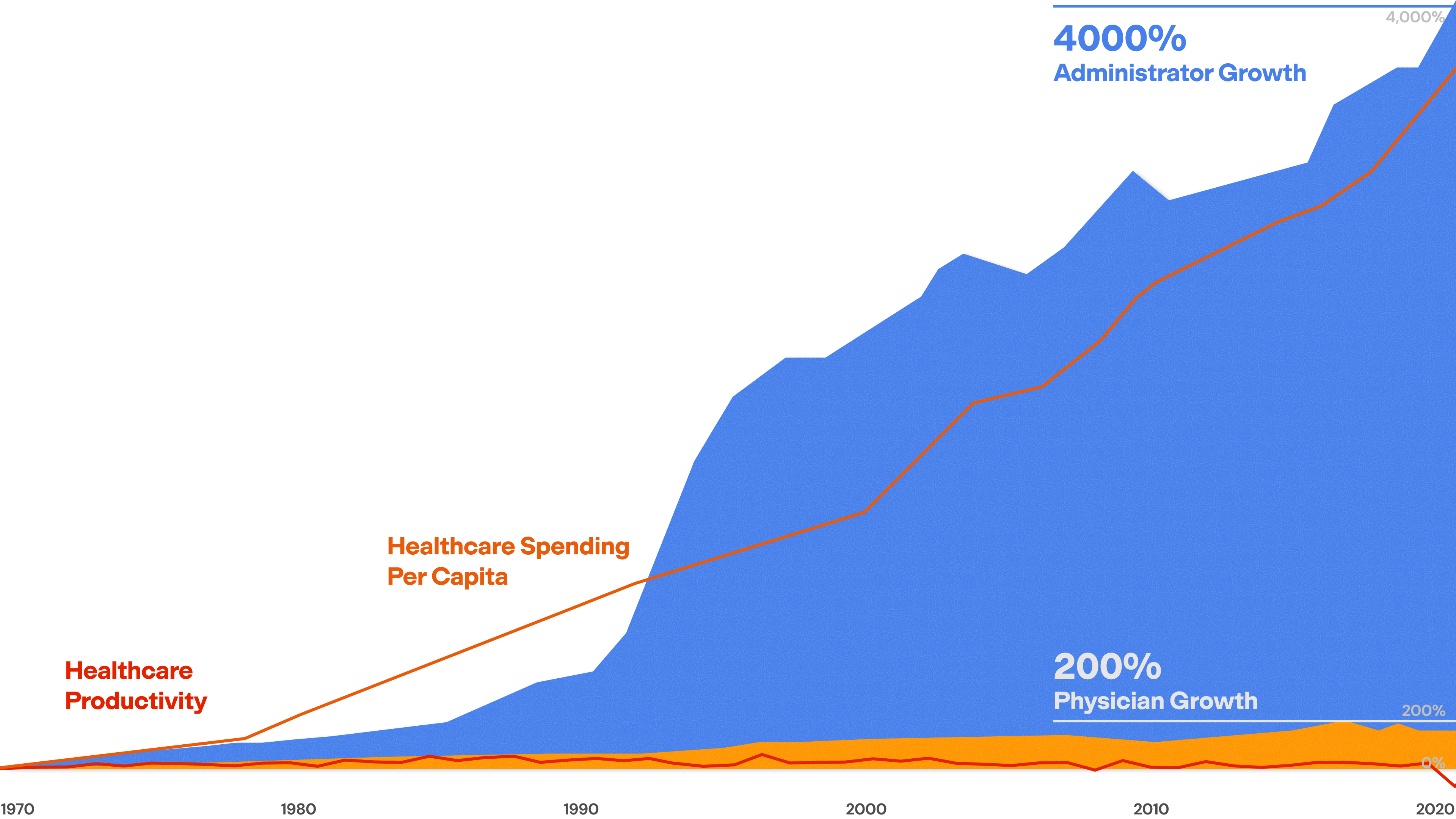
The capacity to deliver care grew arithmetically while the administrative apparatus around it grew exponentially. Yet the production curve, the relationship between clinician capacity and the number of patients served, grew linearly because productivity stayed flat. Every additional patient has required additional people, and nothing has ever relieved that pressure.
Economists have a name for this trap: Baumol's cost disease. Labor-intensive sectors like healthcare struggle to capture the productivity gains that transformed other industries like manufacturing and software, and as a result, their costs rise relentlessly relative to everything else. Healthcare administration is the purest case of this in the American economy. The work behind the scenes to deliver care, such as prior authorizations, billing, denials, eligibility, scheduling, coding, and follow-ups, is an extreme pattern of this coordination work done by people at a scale that compounds each year.
So far, software has had no impact on fixing this. EHRs digitized paperwork, and while they improved patient outcomes by making information readily available, they didn't reduce the number of people required to push that paperwork. RPA also fell short of its promises, with brittle bots automating keystrokes while the coordination burden kept growing around the people it tried to automate.
Agentic AI is the first technology with the promise to bend this curve, because it doesn't just speed up a task inside the structure. It can replace the coordination function the structure exists to perform. That is the difference between a 5% efficiency gain and a different cost basis for running a healthcare organization.
"5% more efficient at a process that shouldn't exist is still 95% inefficient."
The organizations that internalize this first won't just have a lower cost-to-collect. They will operate on a fundamentally different production curve than their peers, generating more revenue per FTE, getting cash in the door faster, and scaling administrative capacity without scaling headcount. These organizations could absorb growth without absorbing cost rather than having to choose between the two.
Every health system pursuing AI today is on one of two paths, whether they've named it or not.
Path one is tool adoption. You buy AI features, give copilots to staff inside the existing hierarchy, and every person gets a little faster but the structure stays exactly the same. This is a safe path, and it produces comfortable results with single-digit efficiency gains that disappear into the noise of a budget cycle. Tool adoption automates down, taking the tasks at the bottom of the pyramid and shaving a few minutes off each one.
Path two is transformation. Enterprises can redesign their operations around what AI can now own. Agents run entire workflows end to end, so humans move to the edge of the process and do the things only they can do: judgment calls, exceptions, building relationships, and delivering care. The coordination that required layers of management becomes intelligence built into the system, and the multiple levels of hierarchy collapse into two.
We think of this as automating up, not down. It's the difference between an AI initiative that shows up on a board slide and one that shows up in your financials.
Transformation is meant to be a climb, not a leap. We map every organization we work with against five levels. Finding yours is the first honest step.
Level 1, Rules and robots. Leveraging macros, scripts, and RPA bots that follow explicit instructions on structured inputs. Useful, but brittle and expensive to maintain as every payer portal change breaks something. Most health systems have been here for a decade, and the ceiling is that rules can't handle the ambiguity that makes up most administrative work.
Level 2, Assistive AI. Software with AI features built in. Copilots draft appeal letters, summarize accounts, and suggest codes. Individual staff get faster, but every workflow still routes through a human, and the org chart is untouched. This is where much of the industry sits today and where tool adoption stalls. The ceiling here is that you've made each seat more productive without needing more seats. Your capacity is still bounded by the number of people you have, which means the only way to grow is still to hire.
Level 3, Autonomous workflows. Agents own discrete, well-defined workflows end to end, with humans reviewing by exception rather than by default. This is the first level where the production curve visibly moves, because work completes without a person in the loop. The ceiling is that these workflows are automated in silos, so the coordination between them is still entirely human.
Level 4, Coordinated agent operations. Fleets of agents that work across functions, hand off to each other, escalate intelligently, and are managed the way you'd manage a team, with performance visibility, quality controls, and clear ownership. Supervisors oversee agent capacity the way they once oversaw human capacity, and the organization can restructure around this so there are fewer coordination roles, and more exception-and-judgment roles.
Level 5, The agentic organization. Intelligence is the coordination layer, so information moves through the system without hierarchy moving it. Humans sit at the edge as clinicians, decision-makers, relationship owners, and administrative capacity scales with compute instead of headcount. The production curve is no longer linear. This is the destination, and no one in healthcare is fully there yet. The market leaders will be within the decade.
Two things are true about this pyramid. First, you can't skip levels. An organization that has never trusted an agent with a workflow can't leap to coordinated fleets. Second, the value is wildly non-linear. Levels 1 and 2 are measured in minutes saved. Levels 3 through 5 are measured in the shape of your labor cost structure.
Here's the uncomfortable truth about why so many AI initiatives in healthcare quietly stall at level 2: transformation is not a procurement decision.
Software vendors sell you a tool and a login, but the climb from level 2 to level 4 runs through the messiest parts of an enterprise across legacy systems, undocumented processes, payer idiosyncrasies, staff who have every reason to be skeptical, and workflows that exist only in the heads of the people running them. There isn't a tool out there that can absorb these headwinds on its own.
Someone has to do the hard work of transformation: map the process, deploy against your actual systems, and earn trust one workflow and one team at a time. Then redesign the roles as agents take on more.
Trust is the hardest part of that work, and it should be. Handing a workflow to an agent in healthcare carries real exposure: audit risk, compliance obligations, and payer relationships that a single bad automated touch can damage. Leaders who slow down here aren't being change-averse, they're being responsible. But this is also why the climb can't be skipped. Agents earn autonomy the way a new employee does, by starting under full review and expanding scope only as accuracy holds.
The model that works, in healthcare and any other industry undergoing this shift, pairs the technology with the people deploying it. What you should be looking to buy isn't software, but rather outcomes delivered by a team you hold accountable for making the transformation real inside your organization, on your systems, with your people. The technology matters enormously, but the technology alone cannot transform your organization.
Transformation carries the connotation of a multi-year odyssey. In practice it starts far smaller: one workflow with a clear financial signature, a measurable baseline, deployment against production systems with humans reviewing everything, and a deliberate redesign of the roles it touches.
Each pattern compounds. Each workflow makes the next one faster to deploy. Each accurate run earns the agent more autonomy. And somewhere along the way, the conversation shifts from "should we automate this task" to "what should this department look like."
American healthcare spends on the order of $1.5 trillion a year on administration to do coordination work that agentic AI can increasingly perform. That money isn't abstract, it's the gap between what care costs and what care should cost for every American, whether they're a patient or an employer.
For your organization, the stake is more immediate. Bending this curve is the difference between an organization that can grow without growing its administrative cost base and one that will keep paying more every year for the same output, against competitors who no longer have to.
This transformation won't be accomplished by giving every administrator a copilot, but it will be accomplished by leaders willing to ask the rebuild question honestly: what would this organization look like if we rebuilt it today? And then to climb, level by level, until the answer and the reality converge.
The technology is ready. The economics are undeniable. The only variable left is which organizations move first.
Hospitals lose $19.7B annually fighting denials, yet 54% get overturned on appeal. This guide covers essential appeal metrics, effective submission strategies, and how AI automation reduces appeal time from 4 hours to 15 minutes.
X min read
Hospitals lose $19.7B annually fighting denials, yet 54% get overturned on appeal. This guide shows how AI automation reduces appeal time from 4 hours to 15 minutes while increasing success rates. Start reclaiming your revenue today.
Nearly 15% of all medical claims submitted to private payers and approximately 16% of Medicare Advantage claims were initially denied in 2024, with inpatient care facing an even higher denial rate of 14.07% (Premier Inc., 2024). This concerning trend creates significant financial strain for healthcare providers, with hospitals spending an estimated $19.7 billion annually fighting denied claims. What's more alarming is that more than half of denied claims (54.3%) are eventually overturned after costly appeals processes, indicating many denials should never have happened in the first place.
As inpatient care represents some of the most complex and highest-value claims in healthcare, mastering the appeals process has become essential for protecting revenue integrity. This guide provides hospital administrators and revenue cycle teams with practical strategies to optimize inpatient appeals submission, reduce administrative burdens, and maximize successful outcomes.
Inpatient claims involve intricate coding requirements, extensive documentation, and complex medical decision-making that must be clearly communicated to payers. Documentation must effectively demonstrate medical necessity for the admission, appropriate level of care, accurate DRG assignment, and clinical validation of diagnoses. With 46% of providers identifying missing or inaccurate information as the primary cause for claim denials (Experian Health, 2024), ensuring comprehensive documentation is critical.
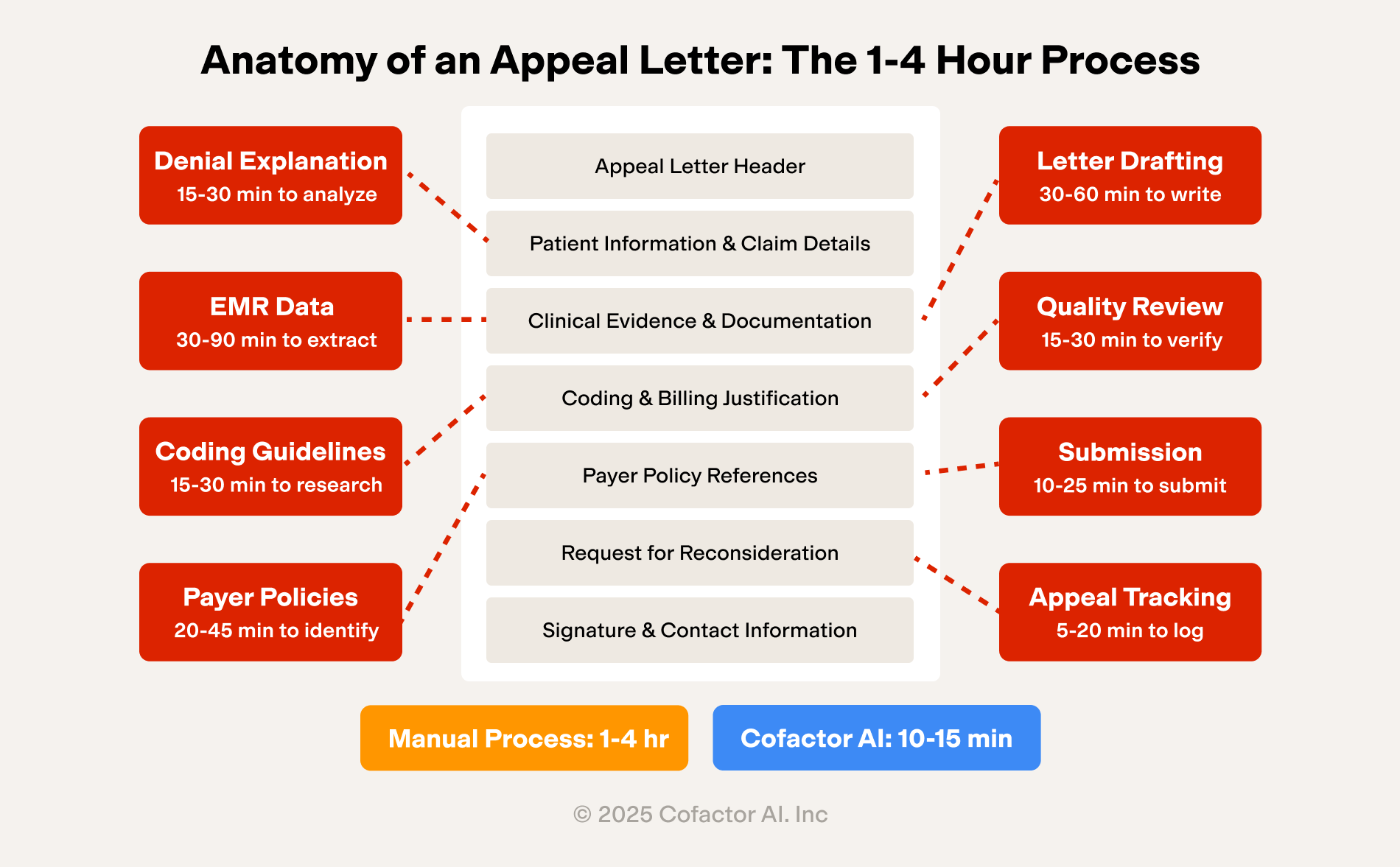
The traditional appeals process is highly manual and time-intensive. A typical denial appeal requires a clinical professional to:
With revenue cycle teams already stretched thin due to staffing shortages affecting 83% of healthcare organizations (American College of Healthcare Executives, 2024), the growing volume of denials creates an unsustainable workload.
Each payer has unique submission requirements, deadlines, and appeal processes that must be carefully navigated. Missing a deadline or failing to include required documentation can result in automatic rejection of the appeal, regardless of its merit.
Initial Denial Rate (IDR): Measures the percentage of claims denied upon first submission. The industry average for inpatient claims is approximately 14%, but high-performing organizations aim for single digits.
Appeal Success Rate: Tracks the percentage of appealed denials that result in payment. Organizations should aim for success rates above 60%, with many achieving 70–80% for properly selected and executed appeals.
Appeal Submission Rate: Measures what percentage of eligible denials actually get appealed. Due to resource constraints, many organizations appeal less than 50% of denied claims, leaving significant revenue uncollected.
Days in Accounts Receivable (A/R): Appeals significantly extend the revenue cycle. The average time to resolve an appealed claim is 45–90 days, with some complex cases extending beyond 120 days.
Cost to Appeal: The average cost to appeal a denied claim is approximately $44 per appeal, not including clinical labor costs which can add $13–51 per claim depending on complexity (Premier Inc., May 2024).
Not all denials are created equal. Prioritize appeals based on:
Create a scoring system that incorporates these factors to objectively rank denials requiring appeals.
Successful appeals require thorough analysis of the medical record to identify evidence supporting the claim:
Ensure the appeal directly addresses the specific reason for denial with relevant clinical evidence.
The appeal letter is your opportunity to present a compelling case for payment. Effective appeal letters should:
Always maintain a professional, fact-based tone rather than an emotional or confrontational approach.
Create specialized appeals teams with the right mix of clinical and revenue cycle expertise:
This specialized approach allows team members to develop deep expertise in their area of focus.
Modern technology can significantly enhance the efficiency and effectiveness of the appeals process:
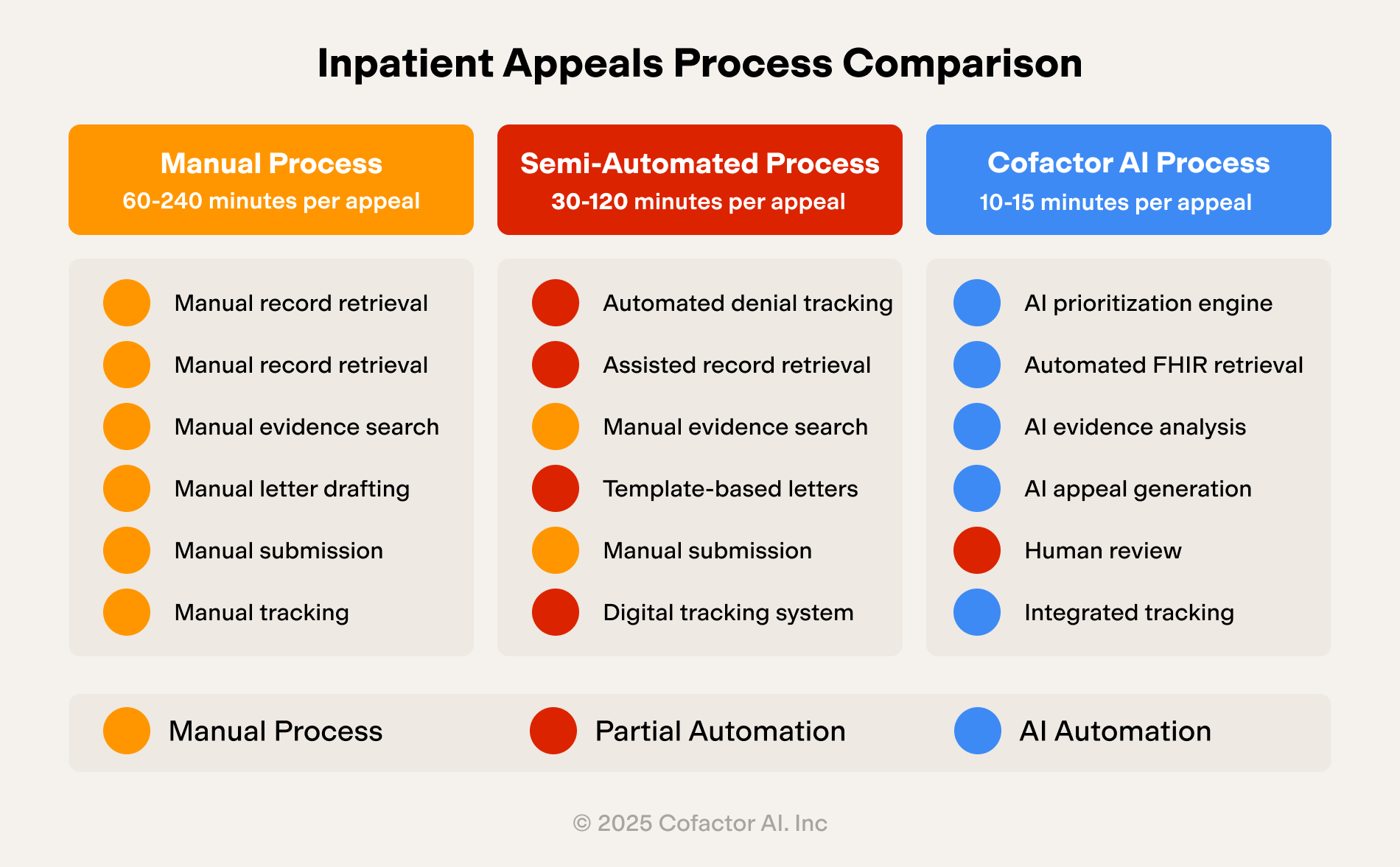
The traditional manual appeals process typically follows these steps:
This process typically takes 60-240 minutes per appeal, limiting the volume of appeals that can be processed.
Semi-automated solutions offer incremental improvements:
While more efficient than fully manual processes, semi-automated solutions still require significant manual effort for evidence identification and letter customization.
The most advanced approach utilizes AI for intelligent denial prioritization (analyzing patterns and financial impact to recommend which claims to appeal), automated medical record analysis (reviewing The most advanced approach utilizes artificial intelligence to transform the appeals process through:
This approach can reduce the time spent on appeals by 80-90%, allowing organizations to appeal a higher percentage of denials while freeing clinical staff to focus on patient care.
Intelligent Prioritization: Cofactor analyzes each denial's financial impact, appeal deadline, probability of success, and historical patterns to ensure your team focuses resources on appeals with the highest potential return.
Automated Evidence Identification: Our AI analyzes the complete medical record through FHIR integration with your EMR, extracting relevant clinical indicators, connecting evidence to specific denial reasons, and compiling evidence from throughout the record, even when it appears in unexpected locations.
Comprehensive Appeal Generation: Cofactor generates complete appeal letters addressing the specific denial reason with relevant clinical evidence, appropriate references to guidelines and policies, and a clear, professional argument, produced in minutes rather than hours.
Human Review and Submission: While Cofactor automates the most time-intensive components, it maintains a human-in-the-loop approach where all appeals undergo final review before submission, ensuring quality control and appropriate submission through your established channels. This transforms what typically takes 1–4 hours per appeal into a process requiring just 10–15 minutes of staff time.
Payers are increasingly employing sophisticated strategies to deny claims, including:
This trend requires equally sophisticated appeal strategies that directly address these complex denial reasons.
Healthcare organizations are rapidly adopting AI tools to address the growing administrative burden. According to a recent survey from Healthcare IT News, organizations using AI for appeals are now able to process denials three times faster than manual methods, allowing clinical staff to focus on patient care rather than paperwork.
These tools can analyze vast amounts of clinical documentation, identify relevant evidence, and generate compelling appeal letters in a fraction of the time required by manual processes.
Forward-thinking organizations are moving beyond simply reacting to denials to implementing preventative strategies. By analyzing patterns in successful appeals, they identify root causes of denials and implement process improvements to prevent future occurrences.
Effective appeals require seamless collaboration between clinical experts who understand medical documentation and revenue cycle professionals who understand payer requirements. Organizations are breaking down silos between these departments to create integrated appeals teams.
The financial impact of inpatient claim denials cannot be overstated. With denial rates at historic highs and more than half of denied claims ultimately being paid upon appeal, an effective appeals strategy is essential for financial sustainability.
By implementing the strategies outlined in this guide and leveraging advanced technology solutions, healthcare organizations can reduce administrative burden, increase appeal capacity without adding staff, improve appeal success rates, shorten the revenue cycle, and generate valuable insights to prevent future denials.
The most successful organizations view denial management not as a cost center but as an opportunity to protect revenue integrity and improve financial performance.

Medicare Advantage claim denials increased 55.7% between 2022 and 2023. This guide provides a practical, step-by-step approach to identifying, preventing, and combating DRG downgrades using AI and strategic operational improvements.
X min read
Recent data from the American Hospital Association reveals that between 2022 and 2023, Medicare Advantage claim denials increased by a staggering 55.7%, representing billions in contested revenue for U.S. hospitals (AHA, September 2024). With hospital operating margins hovering at just 2.5%, DRG downgrades represent a significant threat to financial sustainability. This guide provides hospital administrators with a practical, step-by-step approach to identify, prevent, and combat DRG downgrades using artificial intelligence and strategic operational improvements.
Diagnosis-Related Group (DRG) downgrades occur when payers retrospectively review inpatient claims and determine that a lower-weighted DRG should have been assigned, resulting in reduced reimbursement. Unlike outright denials, these often appear as post-payment adjustments, making them particularly insidious, your hospital may not realize revenue is being reclaimed until it's too late.
Understanding the most frequent downgrade scenarios helps focus prevention efforts:
Deploy AI to analyze historical downgrade patterns by payer, service line, and DRG, develop risk scores for current inpatient stays, and create real-time alerts for high-risk cases before claim submission. Hospital systems implementing predictive analytics can identify which cases are at highest risk, allowing CDI specialists to focus resources before submission.
Use natural language processing to analyze clinical notes against coding requirements, identify documentation patterns that frequently lead to downgrades, and generate physician-specific education opportunities. AI systems can scan thousands of records in minutes to flag potential documentation gaps before submission.
Implement AI that can rapidly search the entire medical record for clinical evidence, automatically extract relevant documentation for appeals, and prioritize appeals based on likelihood of success and financial impact. Leading health systems are using AI to automate appeals for bulk denials from a single payer, allowing staff to focus on cases with the highest potential return.
Use AI analytics to identify payer-specific denial patterns, develop targeted documentation strategies for high-risk DRGs by payer, and establish benchmark metrics to identify anomalous behavior. Analysis might reveal that certain payers consistently challenge specific diagnoses, allowing hospitals to strengthen documentation for those conditions in advance.
Build a cross-functional downgrade defense team including dedicated clinical documentation specialists with DRG expertise, physician advisors with specialty-specific knowledge, certified coders, revenue cycle specialists focused on payer policies, and data analysts to monitor trends. Hold weekly case review meetings, establish clear escalation paths for physician queries, and develop payer-specific response protocols.
Key workflow integration points include pre-discharge documentation checkpoints for high-risk DRGs, coding validation review for AI-flagged cases, post-discharge query opportunities before claim submission, and post-payment review triggering automated evidence collection. Some providers tag accounts with heavily scrutinized diagnosis codes for review before billing to catch issues before submission.
For physicians: specialty-specific documentation requirements, interactive case studies showing documentation gaps, and quick reference guides for commonly challenged diagnoses. For CDI specialists: advanced training on payer-specific clinical validation criteria and query development skills. For coders: advanced DRG optimization within compliance guidelines and payer-specific coding guidance.
Use AI to analyze downgrade patterns by physician, service line, and diagnosis to develop targeted, data-driven education. Some organizations have CDI specialists attend monthly physician staff meetings to explain where inappropriate downgrades occur and share prevention strategies.
The most forward-thinking organizations are shifting from reactive appeals to proactive validation, implementing AI-powered pre-bill reviews that catch documentation gaps before claims are processed. Advanced health systems are developing payer-specific documentation templates guided by AI analysis of historical patterns. Several health systems have formed collaborative networks to share anonymized downgrade data, helping identify emerging payer tactics across organizations. The most significant advancement is AI systems that can automatically generate comprehensive appeal letters, reducing appeal creation time from hours to minutes while increasing success rates.
Cofactor's AI analyzes the complete medical record to identify all relevant clinical evidence supporting the originally coded DRG, automatically compiling it into a comprehensive appeal letter and transforming what typically takes 1–4 hours per case into a 10–15 minute review process.
Our system continuously analyzes patterns in payer behavior, identifying emerging downgrade trends before they become widespread, allowing targeted documentation improvements that protect revenue before downgrades occur. Hospitals using Cofactor's predictive analytics have reduced downgrade rates by up to 30% for high-risk DRGs.
Cofactor integrates with your existing EMR and clearinghouse systems, automatically prioritizing downgrade cases based on financial impact, appeal deadline, and likelihood of success. Hospitals implementing Cofactor's technology typically experience an 80–90% reduction in time spent creating downgrade appeals, the ability to process 3–4 times more appeals with existing staff, and substantial ROI in cost-to-appeal savings.
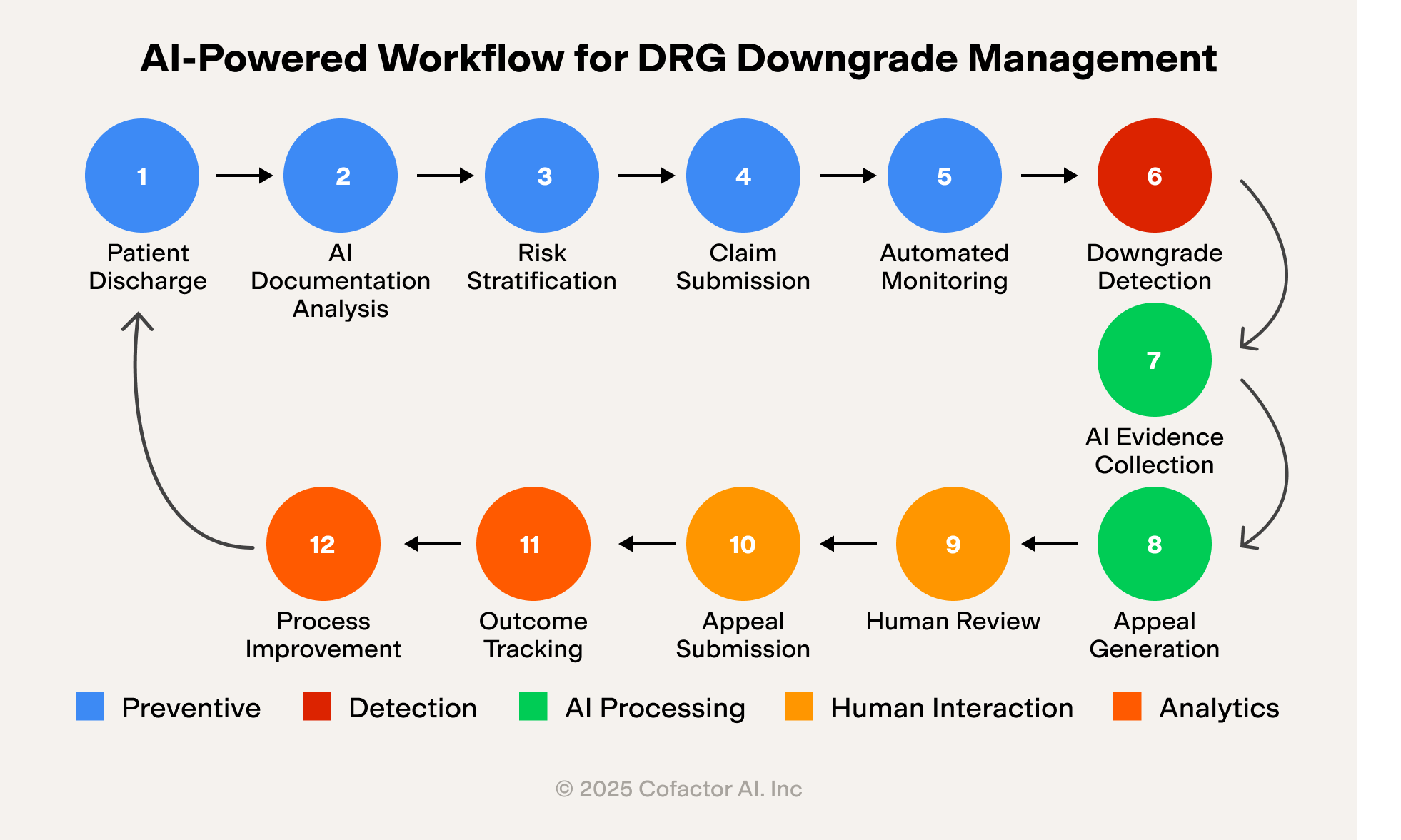
DRG downgrades represent a significant but often underaddressed threat to hospital financial performance. By implementing AI-powered solutions, healthcare organizations can dramatically improve their ability to identify, prevent, and combat these revenue challenges. The result is not only improved financial performance but also reduced administrative burden, allowing clinical and revenue cycle staff to focus on their core mission of providing exceptional patient care.

73% of healthcare providers report claim denials are increasing. This guide breaks down denial management from every stakeholder's perspective, from CFO to CDI director, with practical strategies for appealing inpatient denials at scale.
X min read
According to Experian Health's 2024 State of Claims report, a staggering 73% of healthcare providers report that claim denials are increasing, while 67% feel it's taking longer to get paid. These rising denial rates represent a significant financial challenge, with hospitals spending an estimated $19.7 billion in 2022 trying to overturn denied claims, according to the American Hospital Association. For hospital administrators, developing a strategic approach to appealing inpatient denials at scale has become essential for financial sustainability.
This comprehensive guide provides practical, step-by-step strategies for hospital administrators to improve their denial management processes, particularly for complex inpatient denials such as medical necessity and DRG downgrades.
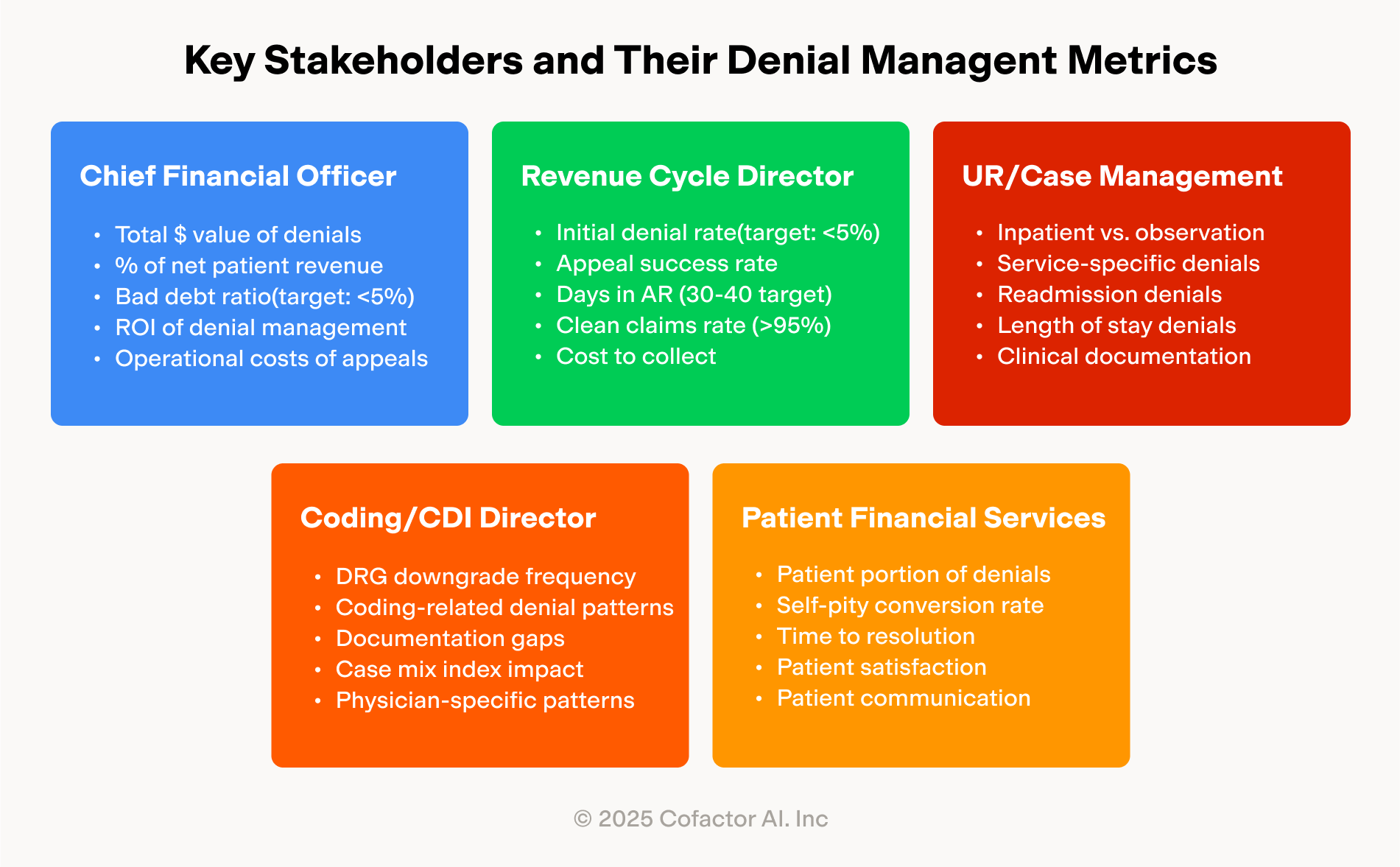
Different stakeholders within a healthcare organization evaluate denial management from unique perspectives. Understanding these viewpoints is crucial for creating an effective, organization-wide approach.
Chief Financial Officer (CFO): Primarily concerned with overall financial impact, monitoring total dollar value of denials and appeals as a percentage of net patient revenue, cash collection as a percentage of net patient service revenue (target: 100%), bad debt ratio (target: under 5%), ROI for denial management initiatives, and operational costs of appeals processing.
Revenue Cycle Director/VP: Focuses on operational efficiency, prioritizing initial denial rate (industry average 5–10%, target under 5%), denial appeal rate, appeal success rate by denial type and payer, days in accounts receivable (target 30–40 days), clean claims rate (target over 95%), and cost to collect.
Utilization Review/Case Management Director: Concentrates on clinical documentation and medical necessity, evaluating inpatient vs. observation status denial rates, service-specific denial patterns, readmission denials, length of stay denials, and physician-specific denial rates.
Coding and CDI Director: Focuses on coding accuracy, monitoring DRG downgrade frequency by service line, coding-related denial patterns, documentation gaps by physician or service, and case mix index impact from denials.
Patient Financial Services Director: Concerned with patient financial experience, tracking patient portion of denied claims, self-pay conversion rate after denials, time to resolution for patient-impacting denials, and patient satisfaction metrics related to billing.
Implement denial classification systems: Categorize denials by type (medical necessity, DRG downgrades, authorization issues), payer, service line, and dollar amount to identify patterns and prioritize high-impact areas.
Track denial rates by physician and service: Monitor denial rates across different providers and service lines to identify specific areas needing documentation or coding improvement.
Analyze payer behavior patterns: Document which payers regularly downgrade specific DRGs or deny particular types of admissions. A Premier Inc. survey found that nearly 15% of all claims submitted to private payers are initially denied, but patterns often exist within these denials.
Conduct regular chart audits: Perform targeted reviews of denied claims to identify documentation gaps or patterns that may be contributing to denials.
Leverage data analytics tools: Implement technology solutions that can detect denial trends and provide actionable insights for process improvement.
Create a specialized denials management team focused solely on managing and appealing denials. Include clinical expertise, since having a physician advisor on the team is considered a best practice according to HFMA. Incorporate certified coders with expertise in inpatient coding guidelines and DRG assignment. Establish clear roles and workflows, and implement accountability metrics like appeal success rates and turnaround times.
Implement denial management software that tracks, prioritizes, and manages denials throughout the appeal process. Automate denial identification and routing. Utilize AI-powered appeals generation, since a study reported by Healthcare IT News found that organizations using AI for appeals processing handle denials three times faster than manual methods. Integrate with EMR systems to streamline documentation retrieval, and develop payer-specific templates addressing common denial reasons.
Provide specialized coding education on inpatient guidelines, with emphasis on areas frequently targeted for DRG downgrades. Develop clinical documentation improvement programs. Conduct payer policy education so team members understand specific requirements for inpatient admissions and DRG validation. Implement peer learning sessions reviewing successful appeals, and support staff in obtaining professional certifications.
Track appeal success rates by denial type, payer, and dollar amount. Measure financial impact by calculating revenue recovered versus the cost of the appeals process. Monitor appeal turnaround times to ensure timely filing. Analyze root cause resolution to evaluate whether denial patterns are being effectively addressed, and implement regular reporting dashboards for real-time visibility.
Healthcare providers are increasingly turning to AI to combat rising denial rates, with over half of surveyed providers now leveraging AI-driven claims management software (Experian Health, 2024). At the same time, a February 2025 AMA survey found 61% of physicians are concerned that health plans' use of AI is increasing prior authorization denials, meaning providers must also adopt sophisticated tools to level the playing field. DRG downgrades have become increasingly common, with providers seeing a 15% to 20% average increase in clinical denials (HFMA, 2023). A strategic shift toward preventing denials rather than just appealing them is also gaining traction.
Cofactor's platform generates comprehensive appeal letters incorporating relevant clinical evidence, appropriate citations, and compelling justification tailored to the specific denial reason, transforming what typically takes 1–4 hours per appeal into a process requiring just 10–15 minutes of staff time.
Cofactor's system analyzes denial patterns to identify root causes and provides actionable insights to prevent future denials, helping protect revenue before it's at risk. The platform automatically retrieves relevant clinical documentation through FHIR integration with your EMR, eliminating manual record searching and reducing the cost to collect.
Cofactor's intelligent prioritization engine evaluates denials based on financial impact, appeal deadline, and likelihood of overturn, ensuring your team focuses on appeals with the highest potential return, helping overturn complex clinical denials that would otherwise be difficult to address.
As denial rates continue to rise, hospitals must evolve from manual, reactive approaches to strategic, technology-enabled denial management processes. By implementing robust root cause analysis techniques, optimizing team structures, integrating advanced technologies, providing targeted staff training, and measuring performance effectively, healthcare organizations can successfully appeal inpatient denials at scale.
The right combination of people, processes, and technology can transform denial management from a drain on resources into a strategic advantage that protects revenue, reduces administrative burden, and ultimately supports the organization's mission of providing quality patient care.
Recovery Audit Contractors recovered over $2 billion in improper payments in FY 2021 alone. Learn how RAC audits work, their financial impact on already-thin hospital margins, and strategies for prevention and effective response.
X min read
According to recent data, Recovery Audit Contractors (RACs) recovered over $2 billion in improper payments in FY 2021 alone, creating a significant financial burden for healthcare providers already operating on thin margins (Auditec Solutions, 2024). What makes these audits particularly challenging is their post-payment nature—they target revenue that has already been accounted for and often spent, forcing hospitals to unexpectedly return funds they believed were secured. In today's healthcare environment, where many facilities have seen their average days cash on hand plummet to a 10-year low of just 196.8 days (with lower-performing hospitals averaging only 128 days) and median operating margins struggling at the 4-5% range, these unexpected recoupments can push vulnerable institutions toward financial collapse (Becker's Hospital Review, 2024).
RAC audits are not random reviews but a systematic examination of past Medicare claims designed to identify improper payments. Here's how the process unfolds:
What makes these audits particularly disruptive is their post-payment nature. Unlike pre-payment reviews that withhold funds before they reach the hospital, RAC audits target revenue that has already been received, recorded, and typically spent on operations.
RACs specifically target medical necessity issues (services deemed not medically necessary or provided in an inappropriate setting), coding errors (incorrect codes resulting in higher reimbursement), documentation deficiencies (missing or incomplete documentation), DRG validation (ensuring the DRG accurately reflects the patient's condition), and duplicate billing.
When RACs recover payments for claims that may be up to three years old, they create significant cash flow disruptions. The median operating margin for hospitals reached just 4.4% in October 2024, leaving little room for unexpected financial demands.
The impact is particularly severe for already-vulnerable hospitals. Currently, over 700 rural hospitals face the risk of closure, including more than 300 hospitals at risk within the next three years (Advisory Board, 2025). For these institutions, unexpected recoupment demands can act as the final financial straw.
Responding to RAC audits requires significant administrative resources, diverting staff time away from patient care and other critical functions.
The three-year lookback period for RAC audits creates prolonged uncertainty in financial planning, since revenue recognized years ago may suddenly be reclaimed.
Understanding why denials occur is essential for RAC denial prevention. Begin by categorizing denials based on common patterns. Historically, medical necessity denials have represented the most costly complex denials, with a significant percentage reported because care was provided in the "wrong setting," not because the care wasn't medically necessary.
For each denial category, trace the process backward to identify the point of failure: documentation inadequacies, coding inconsistencies, clinical decision-making processes, communication breakdowns between departments, or technology limitations. Create a cross-functional denial management team representing clinical, coding, billing, and compliance departments to review high-value denials and develop corrective action plans.
Establish a specialized team including a RAC coordinator, clinical documentation specialists, certified coders with expertise in RAC focus areas, financial analysts, and legal counsel familiar with healthcare regulations. Hospitals with dedicated RAC response teams achieve higher appeal success rates and experience less disruption to normal operations.
Develop clear communication channels between departments involved in the audit process, and implement a structured workflow that defines responsibilities and timelines for each step, from receiving record requests to filing appeals.
Audit Management Software: Invest in specialized software that tracks record requests, denials, and appeals, providing real-time visibility and automating documentation and follow-up.
Predictive Analytics: Implement analytics that identify potential denial risks before claims are submitted, flagging claims that share characteristics with previously denied claims.
Electronic Health Record Integration: Ensure your EHR captures documentation necessary to support medical necessity and coding decisions, with custom templates guiding clinicians for high-risk services.
Clinical Documentation Improvement: Train clinicians on documentation requirements specific to RAC focus areas, including medical necessity documentation, appropriate level of care determination, and complete procedural documentation.
Coding Accuracy: Provide regular updates on RAC target areas and coding guideline changes.
Appeal Writing Skills: Teach staff to construct effective appeal letters addressing the specific denial reason with appropriate supporting evidence, rather than generic templates.
Monitor overall denial rate by dollar value and volume, appeal success rate by denial type, average resolution time, administrative cost per audit, and staff productivity metrics on a monthly basis. Conduct regular internal audits mirroring RAC focus areas, and benchmark performance against industry data from HFMA and the American Hospital Association.
According to HFMA, 90 percent of all denials are preventable, and two-thirds of those preventable denials can be successfully appealed. This preventative approach has proven more cost-effective, especially considering hospitals and health systems expended approximately $19.7 billion in 2022 appealing denied claims.
AI and machine learning are revolutionizing denial prevention by identifying patterns and predicting potential issues before claims are submitted.
Healthcare systems are moving toward centralized audit management functions that coordinate responses across multiple facilities, ensuring consistency and shared resources.
With medical necessity continuing to be the primary reason for RAC denials, hospitals are implementing more robust processes for determining and documenting medical necessity.
Cofactor's AI technology analyzes denial documentation and generates comprehensive, evidence-based appeal letters tailored to the specific denial reason, transforming what typically takes 1–4 hours per appeal into a process requiring just 10–15 minutes of staff time. Our platform automatically retrieves relevant clinical documentation through FHIR integration with your EMR.
Our sophisticated prioritization engine evaluates financial impact, appeal deadline, and likelihood of overturn for each denial, helping your team focus where they'll have the greatest impact. By analyzing patterns in denial data, Cofactor helps identify emerging denial trends that might indicate new payer policies or documentation gaps.
RAC audits represent a significant challenge for hospitals, particularly due to their post-payment nature that disrupts cash flow and creates financial uncertainty in an industry already struggling with thin margins. By implementing robust prevention measures, optimizing your team structure, leveraging technology, and investing in staff training, your organization can reduce the financial and administrative burden of audits while improving overall revenue integrity.
Case Mix Index is a powerful financial lever that directly impacts payer contract negotiations. Learn how CMI ties to reimbursement, denials, and negotiation leverage, plus strategic approaches to documentation and contract preparation.
X min read
Healthcare providers are experiencing increasing financial pressure, with PwC projecting an 8% year-on-year medical cost trend in 2025 for the Group market, driven by inflationary pressure, prescription drug spending, and behavioral health utilization (PwC, February 2025). Meanwhile, mergers and acquisitions in the healthcare sector demonstrated continued resilience in 2024 despite a 9% decline in deal volume from 2023 (Fierce Healthcare, January 2025). In this complex financial landscape, understanding how Case Mix Index (CMI) impacts contract negotiations has become crucial for hospital administrators seeking to secure favorable reimbursement terms with payers.
Case Mix Index is a metric that reflects the diversity, complexity, and severity of patients treated at a healthcare facility. Used by the Centers for Medicare and Medicaid Services (CMS) to determine hospital reimbursement rates for Medicare and Medicaid beneficiaries, CMI is calculated by adding the relative Medicare Severity Diagnosis Related Group (MS-DRG) weight for each discharge and dividing by the total number of Medicare and Medicaid discharges in a given period (Definitive Healthcare, 2024).
These metrics carry significant financial implications, as increased CMI results in higher reimbursement and lower adjusted cost per patient per day, which equates to significant revenue enhancement for hospitals. It also positively impacts Observed Over Expected (O/E) ratios for quality scores, including mortality and expected complications.
The financial implications of Case Mix Index are substantial and measurable. Hospitals with the highest CMIs in the U.S. have values ranging from 0.56 to 5.89, with an average CMI of 1.84 (Definitive Healthcare, 2025). Specialized facilities performing complex procedures like spinal surgery, cardiac surgery, and orthopedic surgery typically have higher CMI values, directly translating to higher revenue since Medicare reimbursement is calculated based on these values.
A historical analysis demonstrates the powerful financial effect of even small CMI changes. In 1984, Medicare paid hospitals 5.6% more per admission than planned because the Case Mix Index increased 9.2% when only a 3.4% increase had been projected (NIH PMC, 1986). This unexpected growth in CMI created a substantial windfall for hospitals that effectively documented patient complexity.
More recently, healthcare facilities have shown that focused CMI improvement initiatives yield impressive financial returns. Some hospitals implementing targeted documentation programs have seen CMI increases of 14.3% in the first year and an additional 23% increase after continued focus, directly boosting reimbursement (The Shift, 2023).
The relationship between CMI and claims denials creates a critical financial pressure point for hospitals. According to recent data, 41% of healthcare organizations experience denial rates of at least 10%, with some facing rates exceeding 15%, representing substantial lost revenue (Experian Health, 2025). Initial claim denials reached 11.8% in 2024, up from approximately 10.2% in prior years (OS Healthcare, 2025). Many of these denials directly relate to documentation deficiencies that also impact CMI.
A comprehensive study by Premier Inc. revealed that nearly 15% of medical claims submitted to private payers for reimbursement were initially denied, with Medicare Advantage plans denying 15.7% and Managed Medicaid denying 15.1% of claims (TechTarget, 2024). These denial patterns closely align with cases where CMI documentation may be questioned.
The cost of addressing these denials is substantial. Hospitals fighting denials spend an average of $47.77 per Medicare Advantage claim and $43.84 per claim across all private payers in administrative costs alone (STAT News, 2024). This expense compounds the financial impact of inadequate CMI documentation.
Poor documentation affects both CMI accuracy and denial rates through the same mechanism. Research indicates that private hospitals increased their average CMI nearly three times more than public hospitals over the same period, not because they treated sicker patients, but primarily due to better documentation and coding practices (NIH PMC, 2014).
The connection between documentation and denial prevention is equally clear. The Journal of Managed Care & Specialty Pharmacy reports that the burden of denied claims totals around $260 billion annually, with nearly half of providers (46%) identifying missing or inaccurate information as the primary cause for denials (Experian Health, 2024).
The CMI's influence extends directly to contract negotiations with private payers. Analysis shows that diagnosis-related group (DRG) weight, the foundation of CMI, explains approximately 37% of cost variability in hospitalization expenses (NIH PMC, 2024). This figure provides leverage in negotiations, allowing hospitals to demonstrate their actual care complexity.
The challenge has intensified in recent years as relationships between health systems and health plans have worsened, with 80% of surveyed CFOs blaming health plans for "intentional or systematic efforts to increase denials," forcing 75% of healthcare organizations to add financial services staff to manage the process (HFMA, 2024).
When a facility correctly uses technology to produce accurate documentation and coding accuracy, it can provide more precise reimbursement claims. A comprehensive root cause analysis should include a review of physician documentation patterns, an audit of coding practices, an assessment of clinical documentation improvement (CDI) program effectiveness, and an evaluation of EMR templates and tools that support accurate diagnosis capture.
Your hospital's CMI is directly influenced by the types of services provided. Many hospitals with high CMI values specialize in spinal surgery, general or orthopedic surgery, or cardiac procedures, which involve complicated patient procedures and are reimbursed at a higher rate. Analyze your current service mix to determine which service lines contribute most positively to your CMI, opportunities to expand high-complexity services, and areas where your facility has unique expertise that could justify higher reimbursement.
Different payers have varying impacts on your overall CMI. Publicly insured patients (Medicare and Medicaid) often have different documentation and coding requirements than commercial payers.
Create a dedicated CDI team including physician champions who understand documentation importance and can influence peers, CDI specialists who review documentation concurrently and query physicians, coders who translate documentation into accurate codes, and data analysts who track CMI metrics.
Integrate CMI improvement with revenue cycle management across pre-service (incorporating CMI considerations into service line planning), point-of-service (real-time documentation tools), post-service (reviewing documentation before submission), and financial analysis (incorporating CMI into performance dashboards).
Your EMR should support accurate documentation through smart templates that prompt physicians to document key clinical indicators, embedded MS-DRG criteria within workflows, and real-time alerts for potentially missing documentation.
Leverage natural language processing to identify documentation gaps, predictive analytics to forecast CMI trends, and comparative benchmarking against peer institutions.
The most effective way to improve CMI is through thorough documentation training and consistent follow-through. Develop physician training covering new provider onboarding, specialty-specific training, and regular updates on requirements and metrics. Invest in coding staff through certification support, regular education on coding guidelines, and specialty training in complex service lines.
Establish a dashboard tracking overall CMI by month/quarter/year, CMI by service line, documentation compliance rate, query response rate, and CMI impact on reimbursement. Implement monthly CMI review meetings, quarterly trend analysis, and annual strategic planning that incorporates CMI goals.
Healthcare continues shifting toward value-based care models, making CMI increasingly important for risk adjustment and resource allocation. Payer scrutiny is increasing, with some providers reporting payers preauthorizing treatment plans but later denying payment. Ongoing inflationary pressures make effective CMI management and favorable contract negotiations even more critical, and price transparency data presents a valuable asset for negotiation as access to comparative data changes the negotiation landscape.
Providers should start preparing at least 12 months before the contract renewal date, gathering data on current reimbursement rates, analyzing payer performance, and understanding market trends. When preparing for negotiations, analyze historical CMI performance, benchmark against peers, calculate the financial impact of CMI changes, and identify service line strengths.
Use your CMI data to demonstrate the complexity of your patient population, highlight quality outcomes connected to CMI, show cost efficiency in managing complex cases, and present trend analysis to support future projections. A transparent, data-driven strategy creates an opportunity for building a strong partnership with the payer based on mutual respect and understanding.
Cofactor's AI-powered platform streamlines the entire denials management process, analyzing and prioritizing denials based on financial impact, appeal deadline, and likelihood of overturn. When a denial occurs due to CMI-related documentation, our system automatically retrieves relevant clinical documentation through FHIR integration, analyzes payer policies and coding standards, and generates a comprehensive appeal letter with appropriate citations.
Our platform provides pattern recognition that identifies emerging denial trends, predictive models to estimate overturn probability by payer, and data-driven insights to guide prioritization. This transforms what typically takes 1–4 hours per appeal into a process requiring just 10–15 minutes of staff time, freeing your team to focus on strategic initiatives like CMI optimization and contract preparation.
Case Mix Index is far more than a clinical metric, it's a powerful financial lever that directly impacts contract negotiations with payers. By understanding the relationship between CMI and reimbursement, implementing strategic improvements to documentation and coding, and leveraging advanced technologies, hospital administrators can transform their approach to payer contracts.
As healthcare faces continued financial pressures, effective CMI management represents one of the most significant opportunities for hospitals to secure fair reimbursement that reflects the true complexity and quality of the care they provide.

Nearly three in four healthcare providers report claim denials increasing between 2022 and 2024. This guide breaks down what medical necessity denials are, where they occur in the revenue cycle, and how to build a systematic prevention and appeals strategy.
X min read
Nearly three in four healthcare providers report that insurance claim denials have increased between 2022 and 2024, with approximately 38% of survey respondents indicating that at least one in ten claims are denied (Experian Health, 2024). Among these denials, those based on medical necessity represent a significant and persistent challenge for healthcare organizations, adding administrative burden and threatening financial stability.
Medical necessity denials occur when an insurance provider determines that a service, procedure, or treatment isn't medically required according to their specific criteria. The term "medically necessary" generally refers to healthcare services or supplies needed to diagnose or treat an illness, injury, condition, disease, or its symptoms that meet accepted standards of medicine.
While this definition sounds straightforward, interpretation varies significantly between providers and payers, creating a common source of friction in the reimbursement process. According to KFF's analysis of HealthCare.gov marketplace insurers, only about 6% of in-network claim denials were based on medical necessity in 2023 (KFF, 2025). However, these denials often involve high-dollar services that significantly impact a provider's bottom line.
Medical necessity denials can have substantial financial implications for healthcare providers. While not always an "all or nothing" scenario, these denials frequently result in complete loss of expected revenue for certain procedures or services, partial reimbursement in some cases, additional administrative costs for appeals and resubmissions estimated at $25–$118 per claim (HFMA, 2022), and delayed cash flow as denied claims move through the appeals process.
The industry standard benchmark for medical necessity denial rates is approximately 5%, but many organizations experience higher rates, particularly for certain high-risk procedures and services (MD Clarity, 2025). Each percentage point above this benchmark represents significant lost revenue opportunity.
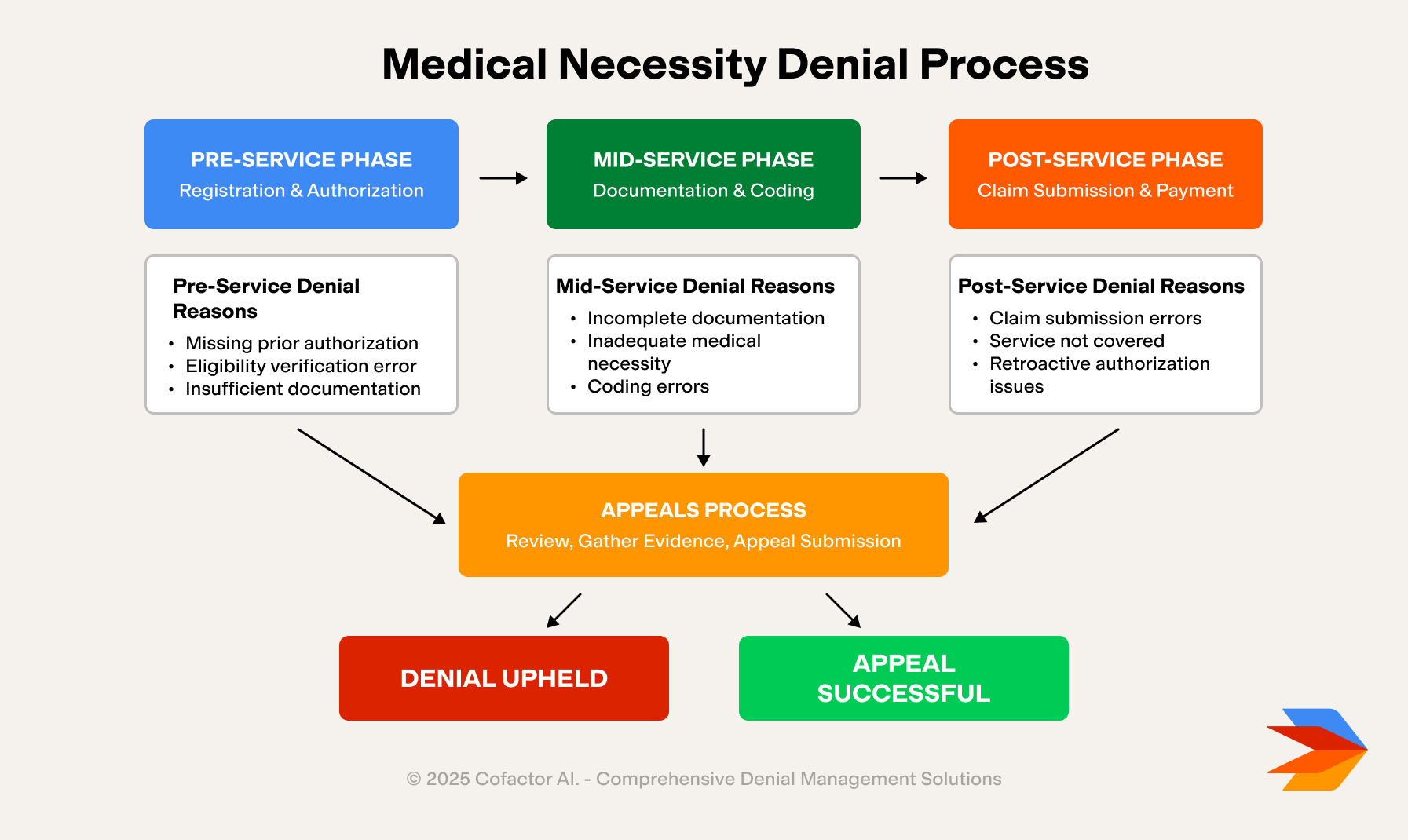
Medical necessity denials can occur at multiple points throughout the revenue cycle, though they most commonly manifest at these critical junctures:
Eligibility verification failing to identify medical necessity requirements, prior authorization rejections due to perceived lack of medical necessity, and patient registration with incomplete or inaccurate documentation. According to Change Healthcare, the front end of the revenue cycle sees the highest concentration of denial triggers, with nearly 27% of denials stemming from registration and eligibility issues (MGMA, 2024).
Clinical documentation that isn't sufficient to establish medical necessity, coding where diagnostic or procedural codes don't align with medical necessity requirements, and charge capture where charges don't match documented medical necessity criteria. This phase is particularly vulnerable as patient documentation must translate into appropriate codes that justify the medical necessity of services rendered.
Claim submission lacking proper documentation or coding, claim adjudication where payers determine services weren't medically necessary, and payment posting where partial payments are received due to medical necessity determinations. Even after a denial occurs, the revenue cycle continues with the appeals process, creating additional work for already strained staff resources.
Advanced imaging studies are frequently targeted for medical necessity denials, including:
Insurance carriers typically require clinical documentation showing that the imaging is necessary based on symptoms, prior treatment failures, or specific diagnostic criteria. For example, Medicare and commercial payers often require documentation of failed conservative therapy before approving MRIs for joint pain (Diagnostic Imaging, 2024).
Cancer-related claims face unique challenges with medical necessity denials:
As new cancer treatments emerge, payers may be slow to update their medical necessity criteria, leading to denials for treatments that oncologists consider standard of care (American Cancer Society, 2024).
Joint replacements and other orthopedic procedures face intense scrutiny:
For joint replacements specifically, many payers require documentation of end-stage joint disease, distinct structural abnormalities, and evidence showing the procedure's benefits outweigh the risks (Coronis Health, 2016). Medicare guidelines outlined in the CMS Major Joint Replacement booklet emphasize the need for detailed documentation of the patient's medical history, failed conservative treatments, and objective findings to support medical necessity (RACmonitor, 2022).
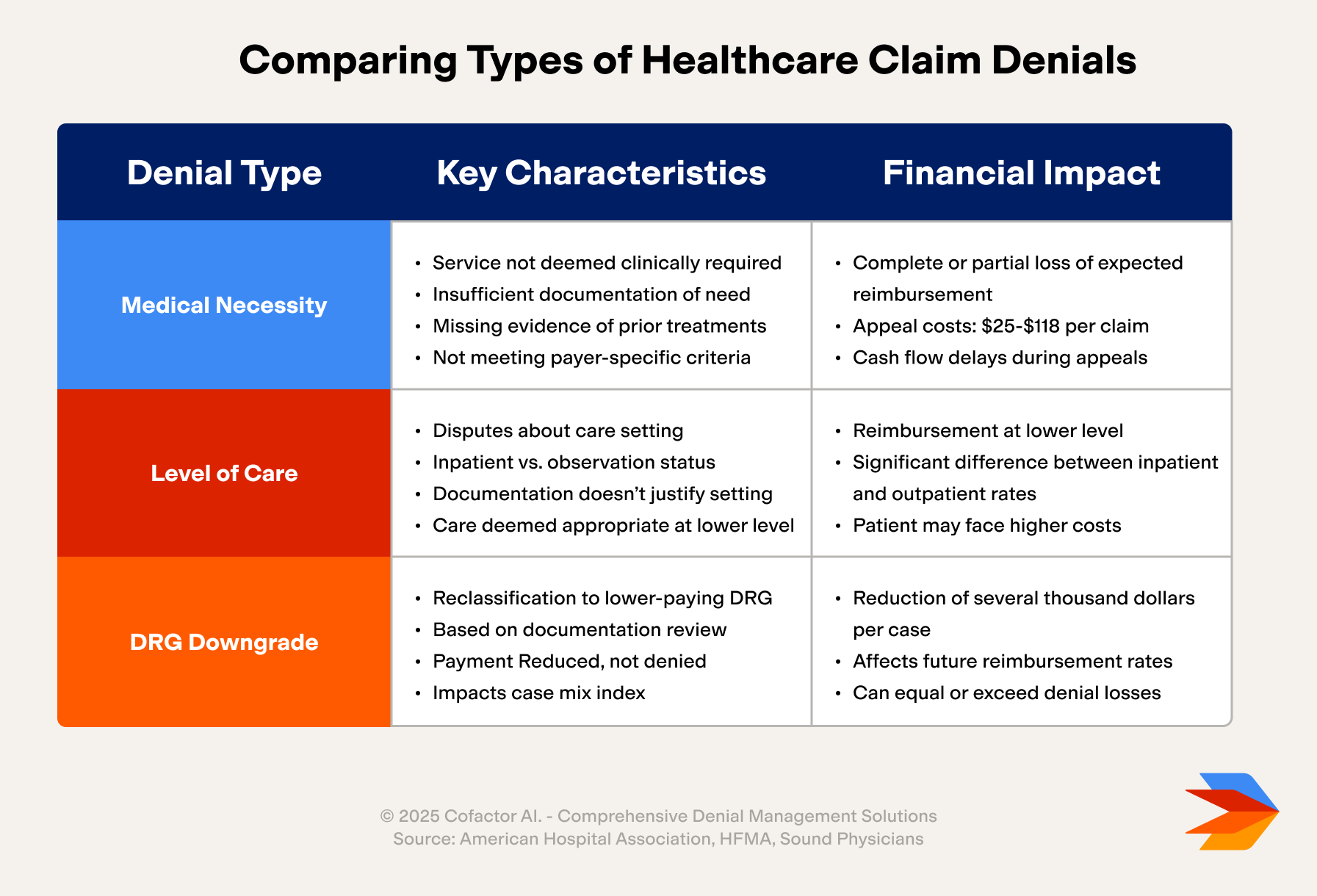
Medical Necessity Denials occur when a payer determines that a service, procedure, or treatment wasn't clinically justified for the patient's condition, focusing on whether the care itself was required, regardless of setting or intensity.
Level of Care Denials focus specifically on the setting where care was provided, not whether the care itself was necessary. These occur when payers believe a service could have been provided in a less intensive setting, such as observation rather than inpatient.
DRG Downgrades differ from outright denials in that the payer doesn't refuse payment entirely but instead reclassifies the patient's stay into a lower-paying DRG category. According to Sound Physicians, DRG downgrades may cost hospitals as much or more than medical necessity denials, with reductions of several thousand dollars per case when, for example, pneumonia with sepsis gets downgraded to simple pneumonia.
Medical necessity denials can arrive in several formats, each requiring a different approach to interpretation and response:
The most common format for denials is through the Electronic Remittance Advice, which contains standardized codes indicating the reason for denial:
For example, CARC 50 is commonly used to indicate "These are non-covered services because this is not deemed a medical necessity by the payer." The X12 organization maintains the official list of these standardized codes used throughout the healthcare industry.
Many payers send formal denial letters that provide more detailed explanations of why services weren't considered medically necessary. These letters typically include:
Increasingly, payers are communicating denials through their provider portals, where additional information may be available:
Patients receive Explanations of Benefits that indicate when services have been denied, often prompting them to contact the provider about the denial. These documents typically show:
Understanding these various formats is crucial for effective denial management, as each format may contain different levels of detail and require different response mechanisms.
When tracking medical necessity denials, hospital administrators should monitor these essential metrics:
Conduct Regular Denial Pattern Analysis: Establish a standardized process to analyze denial trends weekly or monthly, looking for patterns related to specific procedures, individual providers or coders, particular payers, and common documentation gaps.
Implement Clinical Documentation Reviews: Perform targeted audits of documentation for frequently denied services, comparing practices between providers with high and low denial rates.
Evaluate Pre-Service Authorization Processes: Examine accuracy of diagnosis and procedure codes, completeness of clinical information, timeliness of submission, and communication of authorization requirements to clinical teams.
Establish a dedicated cross-functional denial management team representing clinical staff, coding specialists, revenue cycle managers, payer relations representatives, and legal/compliance personnel. Define clear ownership for each step of the process, and consider a case management approach for complex or high-dollar denials.
Implement automated denial prevention tools like claim scrubbing software that flags missing information and applies payer-specific rules. Leverage predictive analytics to identify high-risk claims before submission. Integrate EHR with revenue cycle systems to automatically transfer clinical data and flag documentation gaps in real time.
Develop specialty-specific documentation guidelines, implement regular provider education on payer criteria and documentation best practices, and train dedicated appeal specialists in payer-specific processes and effective appeal letter writing.
Establish KPIs tracking overall denial rate and trend, denial rate by reason/payer/service line/provider, appeal success rate and financial recovery, and average time to appeal resolution. Implement financial impact analysis measuring direct revenue loss, administrative costs, and staff time. Track provider-specific metrics to drive targeted education.
Medicare Advantage plans denied 3.4 million prior authorization requests for health care services in 2022, with a denial rate of about 7%, a share that has increased over recent years (KFF, 2025). This trend extends to medical necessity determinations after services are rendered, with particular focus on inpatient vs. observation status decisions.
The complexity of payer requirements for medical necessity continues to rise. Between March 2020 and March 2022, there were more than 100,000 payer policy coding and reimbursement changes (HFMA, 2024). This complexity makes it increasingly difficult for providers to keep up with requirements across multiple payers.
The healthcare industry is seeing a decline in the use of automation for claims management, with only 31% of providers currently using some form of automation or AI in 2024, down from 62% in 2022 (Experian Health, 2024). This surprising decrease may be related to decreased confidence in how these technologies work, as only 28% feel confident in their understanding of automation and AI, compared to 68% in 2022.
Recent events have increased public scrutiny of health insurer claims practices. A 2023 KFF survey found that 17% of respondents reported an insurer had denied coverage of care recommended by a doctor, with more than half saying neither they nor their doctor challenged the denial (U.S. News, 2024). This heightened attention may lead to regulatory changes and increased pressure on payers to justify denial decisions.
With rising denial rates and the variable financial impact of medical necessity denials, healthcare organizations are facing unprecedented financial vulnerability. According to a 2023 study by the American Hospital Association, a majority of hospitals report having claims that remain unpaid for extended periods, with some claims still unresolved after several years, compounding the financial impact of denials.
Cofactor AI's denials management platform transforms the appeals process by automatically generating comprehensive appeal letters that incorporate the strongest evidence from the medical record, appropriate guidelines, and payer policies, turning what traditionally takes 1–4 hours per appeal into a process requiring just 10–15 minutes of staff time.
Our platform's prioritization engine evaluates each denial based on financial impact, appeal deadline, and likelihood of overturn, ensuring your team focuses efforts where they'll have the greatest impact. Cofactor's AI analyzes medical documentation, payer policies, clinical guidelines, and coding standards to identify the strongest evidence, helping identify documentation gaps and patterns that inform clinician education.
By automating the most time-intensive components of the appeals process, Cofactor enables facilities to appeal a significantly higher percentage of denials without adding staff. Medical necessity denials present a significant challenge for healthcare organizations, but with the right strategies and technology, you can transform this challenge into an opportunity for improved financial performance and operational efficiency.
Stop losing revenue to inpatient vs. observation status denials. AI-powered utilization review helps hospitals correctly classify patients, reduce claim denials, and cut appeal time from hours to minutes.
X min read
Nearly 15% of all healthcare claims submitted to payers for reimbursement are initially denied, with more than half eventually overturned and paid after appeal (STAT, 2024). This staggering statistic highlights a critical challenge for hospital administrators: ensuring patients are classified correctly as either inpatient or observation status. The distinction is far from academic, it significantly impacts reimbursement, determines patient financial responsibility, and influences quality metrics. As claim denials continue to rise (with 77% of providers reporting increases according to a recent survey), healthcare organizations need innovative approaches to enhance their utilization review processes and ensure appropriate patient status determination (Healthcare Dive, 2024).
Before diving into enhancement strategies, it's essential to clarify the fundamental differences between these status designations.
Inpatient Status refers to patients admitted to the hospital requiring medical care that can only be provided in an acute care setting. Medicare and many commercial payers generally require patients to have an expected stay crossing at least two midnights to qualify for inpatient status. Inpatient stays typically involve higher severity of illness, greater intensity of services, expectation of longer duration, and higher reimbursement rates.
Observation Status is designated for patients requiring short-term treatment, assessment, and monitoring to determine whether they need inpatient admission or can be safely discharged. Observation stays typically last less than 48 hours, involve lower severity conditions, result in lower reimbursement, and may lead to higher patient out-of-pocket costs (particularly for Medicare patients).
Hospital administrators face several persistent challenges when managing the inpatient vs. observation designation process:
AI systems can analyze vast amounts of clinical documentation, including physician notes and progress reports, nursing documentation, lab results and diagnostic findings, treatment plans and medication administration, and consultant recommendations. This comprehensive analysis helps identify key clinical indicators that support appropriate status determination, particularly when appealing denials based on status.
By analyzing historical denial patterns, AI can help healthcare organizations identify recurring documentation gaps that lead to status-related denials, recognize payer-specific trends in status determination requirements, target education efforts to improve documentation where most needed, and predict which cases are at highest risk of status-related denials. These insights allow for proactive improvement in status documentation before claims are submitted.
When status-related denials occur, AI can efficiently search through comprehensive medical records to locate relevant clinical evidence, identify documentation that supports the medical necessity of the assigned status, extract key clinical indicators that align with inpatient or observation criteria, and connect evidence to the appropriate coding and billing requirements. This automated approach dramatically reduces the time required to build a strong appeal for status-related denials.
AI excels at identifying patterns across large datasets, allowing hospitals to recognize which service lines have the highest rates of status-related denials, identify physicians who may benefit from additional education on status documentation, pinpoint documentation practices that consistently result in successful appeals, and track the evolution of payer requirements over time.
Create a cross-functional team including case management, utilization review, physician advisors, IT, and revenue cycle leadership to define key performance indicators, establish implementation timelines, develop policies for AI-human collaboration, and monitor outcomes and refine processes.
AI solutions should integrate seamlessly with electronic health record systems, case management platforms, physician documentation interfaces, and revenue cycle management systems. This integration minimizes disruption and maximizes adoption by fitting into established workflows rather than creating new ones.
Success depends on staff understanding and acceptance. Implement comprehensive training programs for case managers and utilization review staff, physician education on AI-supported documentation requirements, regular communication about successes and challenges, and clear escalation pathways when AI recommendations don't align with clinical judgment.
Monitor key metrics including observation to inpatient conversion rates, initial status denial rates, appeal success rates, length of stay for both observation and inpatient cases, case manager time spent on status reviews, and documentation improvement metrics.
Assessment Phase: Analyze current denial rates and patterns specific to status determination, identify key stakeholders across case management, UR, clinical, and IT, define baseline metrics and KPIs for tracking improvements, and evaluate EMR integration capabilities.
Planning Phase: Establish implementation team and governance structure, define clear roles and responsibilities, develop staff training plan, and create communication strategy for all stakeholders.
Technical Setup: Configure EMR integration through FHIR or API connection, set up clearinghouse connections for denial data, test data flows and accuracy, and establish security protocols and access control.
Go-Live & Optimization: Implement in phases, starting with high-volume, high-risk areas, monitor KPIs closely for early intervention, gather feedback and adjust workflows as needed, and provide ongoing education and support.
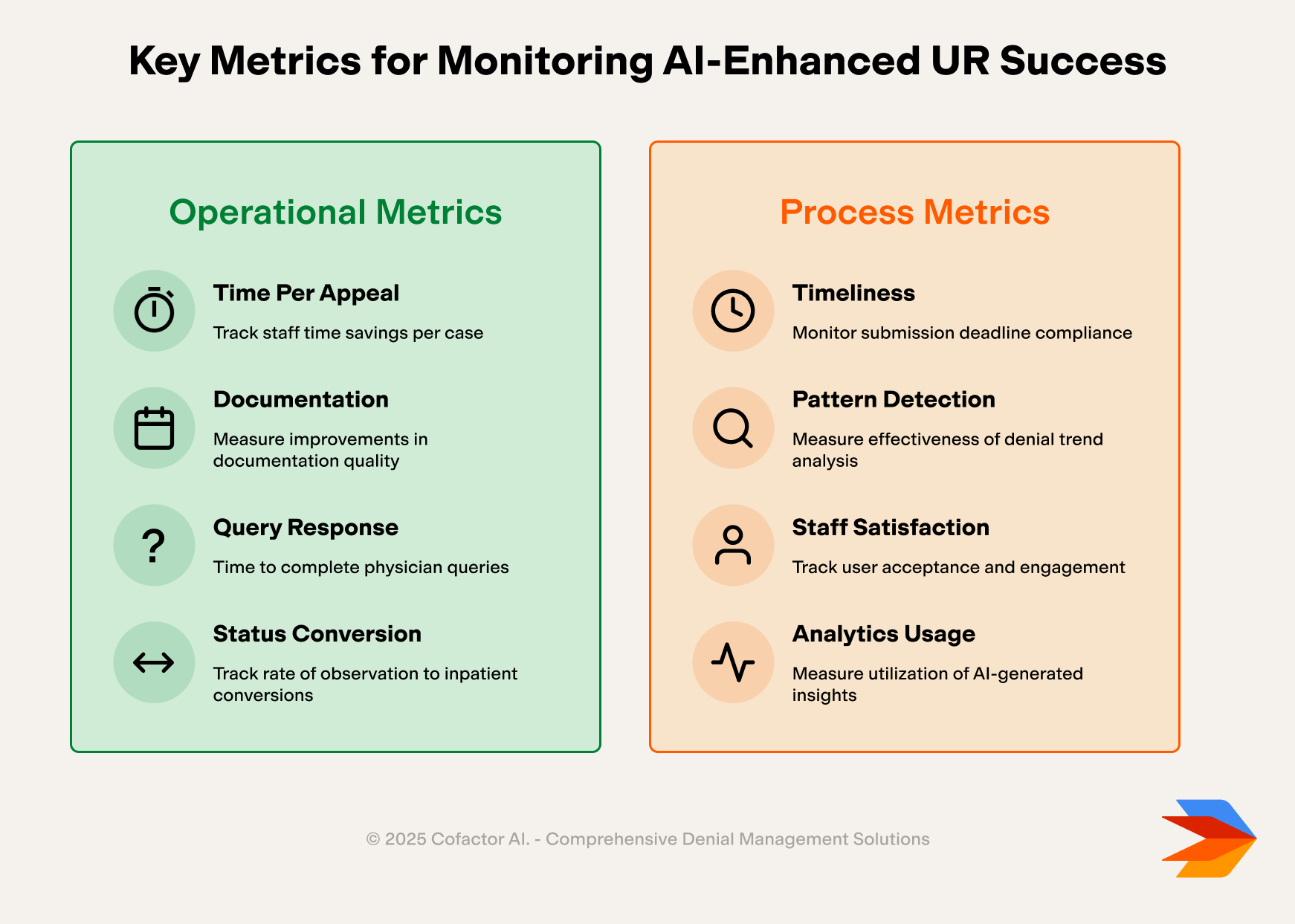
Effective implementation of AI-enhanced utilization review should be measured against specific metrics that reflect both operational efficiency and financial impact.
Financial: Inpatient status denial rate, appeal success rate, revenue recovered from appeals, and cost-to-collect ratio.
Operational: Case manager time per appeal, documentation quality score, physician query response time, and status conversion rate (obs to inpatient).
Process: Appeal submission timeliness, denial pattern identification, and staff satisfaction scores.
Recent guidance from the Centers for Medicare and Medicaid Services (CMS) has addressed the use of artificial intelligence in utilization management processes. While human oversight remains essential for final medical necessity determinations, there's growing recognition of AI's value in supporting clinical decision-making and documentation analysis (Holland & Knight, 2024).
Leading healthcare organizations are shifting from reactive denial management to predictive approaches that identify potential status issues before they occur. This proactive stance reflects the healthcare industry's growing recognition that preventing inappropriate status assignments is more effective than appealing denials after discharge.
Research indicates that social determinants of health significantly impact length of stay and readmission risk. Advanced AI systems are now incorporating these factors into status recommendations, particularly for patients with complex social needs who may require additional services before safe discharge is possible.
Healthcare organizations are increasingly implementing solutions that address the entire appeals lifecycle, from denial identification through appeal generation, submission, and tracking, rather than focusing on individual components of the process.
Cofactor's AI-powered platform addresses the challenges of inpatient vs. observation status determination through several key capabilities:
1. Automated Evidence Analysis: Our AI analyzes medical documentation, payer policies, clinical guidelines, and coding standards to identify the strongest evidence supporting appropriate status assignment. This reduces what typically takes 1–4 hours per appeal into a process requiring just 10–15 minutes of staff time.
2. Intelligent Prioritization: Our proprietary algorithm evaluates the financial impact, appeal deadline, and likelihood of overturn for each denial, helping utilization review teams focus efforts on high-value status appeals with the greatest chance of success.
3. Comprehensive Appeal Generation: When status denials occur, Cofactor automatically generates appeal letters incorporating identified evidence, appropriate citations, and compelling justifications tailored to the specific payer's requirements.
4. Pattern Recognition: Our analytics identify emerging denial trends related to status determination, allowing hospitals to proactively address documentation and coding practices before they lead to additional denials.
By transforming the most time-intensive components of the traditional appeals process (record retrieval, evidence identification, and letter drafting) into automated workflows while maintaining human oversight for quality and compliance, Cofactor provides a balanced approach that maintains the critical human element of utilization review while dramatically improving efficiency.
The distinction between inpatient and observation status remains one of healthcare's most challenging operational areas, with significant financial implications for both providers and patients. By leveraging AI to enhance utilization review processes, hospitals can strengthen their appeal processes for status-related denials, gain insights to prevent future denials, and optimize their revenue cycle.
The future of utilization review lies not in replacing human judgment but in augmenting it with powerful AI tools that provide deeper insights, automate routine tasks, and enable data-driven decision-making. As claim denials continue to rise across the healthcare industry, investing in AI-enhanced utilization review isn't just a technological upgrade, it's a strategic imperative for financial sustainability and operational excellence.

Payer AI systems are processing audits 24/7, targeting high-value DRGs like sepsis and respiratory failure. Learn how revenue cycle leaders are fighting back with AI-powered appeal workflows that reduce processing time by 80-90% and increase appeal volume 3-4x.
X min read
DRG downgrades are on the rise. Medicare Advantage denials increased by 55.7% between 2022 and 2023, with payers increasingly deploying AI-powered systems to systematically challenge high-weighted DRGs like sepsis, respiratory failure, and acute kidney injury.
As VP of Revenue Cycle, you're not just managing today's denial volume, you're preparing your organization for an unprecedented wave of AI-powered scrutiny where documentation gaps will be flagged with surgical precision. The manual review processes that worked in the past simply won't withstand this level of systematic examination.
But here's what we know from hospitals already excelling in this space: organizations with strong documentation practices and modern appeal workflows don't just survive audits, they turn them into competitive advantages. The hospitals that thrive won't be those with the most staff, but those with the best systems and processes.
This guide breaks down what's really driving these downgrades, why the usual approaches don't work, and what you can do to change the equation.
In today's constrained financial environment, every denied dollar represents both immediate revenue loss and opportunity cost that health systems can't afford to ignore.
Payers have dramatically increased their audit capacity through AI automation, creating an unprecedented challenge for healthcare providers.
Volume Mismatch: Payers run AI systems processing 24/7 at machine speed, while hospitals rely on human reviewers working 8-hour shifts with 1–4 hours per case.
Sophistication Gap: Payers deploy machine learning models trained on millions of cases, while hospitals depend on individual reviewers relying on personal experience and manual research.
The math is simple: you can't fight AI with manual processes and expect to win.
Leading organizations are implementing AI-powered workflows that reduce appeal generation time by 80–90% (from hours to minutes), enable a 3–4x increase in appeal volume with existing staff, improve success rates through evidence-based argumentation, and learn and adapt from each case to continuously improve outcomes.
Your role requires thinking beyond individual appeals to system-wide preparation.
Risk Stratification at Scale: High-risk DRGs include sepsis, respiratory failure, encephalopathy, and acute kidney injury. Watch for vulnerable documentation patterns like single-source diagnoses, late additions, and insufficient severity indicators. Track payer-specific triggers to see which payers target which conditions most aggressively.
Resource Allocation Strategy: Based on our analysis of successful implementations, optimal resource allocation follows a 60% prevention (pre-bill reviews, CDI enhancement, real-time documentation improvement), 30% response (efficient appeal generation and submission processes), 10% analysis (performance tracking, trend identification, process improvement) model.
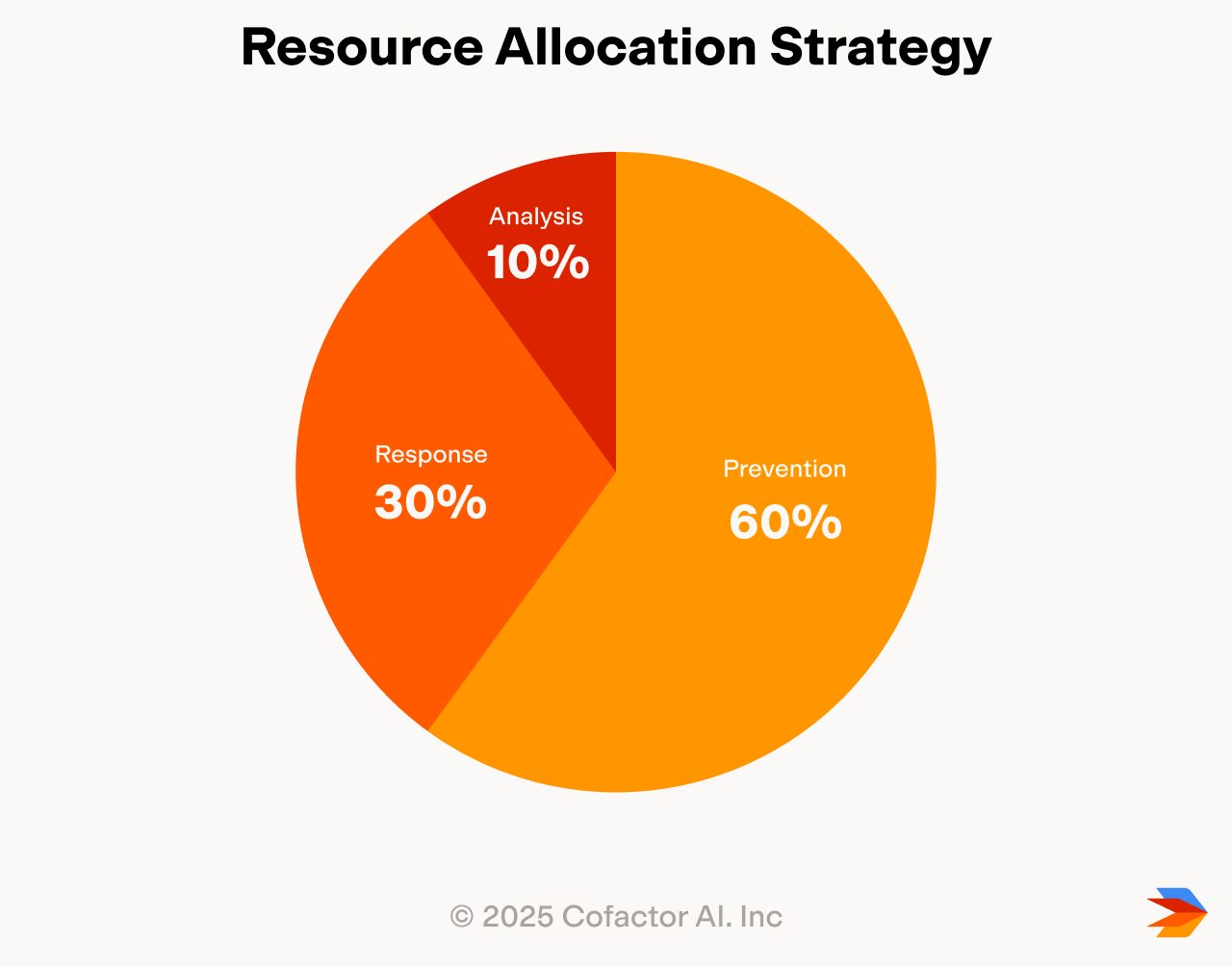
Leading VPs are prioritizing investments in AI-powered documentation analysis systems that can review records at the speed and scale payers now employ, integrated appeal workflows that reduce appeal generation time from hours to minutes, predictive analytics tools that identify high-risk claims before submission, and performance dashboards with real-time visibility into denial patterns and team productivity.
Your success depends on aligning multiple departments toward common goals.
Clinical Documentation Integrity (CDI) Alignment: Link CDI performance to appeal success rates, create real-time feedback loops where appeal outcomes inform CDI education priorities, and use appeal data to demonstrate documentation impact to clinical staff. Leading health systems have demonstrated that targeted CDI interventions based on historical appeal patterns can reduce DRG downgrades by up to 30%.
Health Information Management (HIM) Coordination: Establish protocols ensuring uniform application of guidelines across coders, implement pre-bill coding reviews for high-risk cases, and provide regular updates on payer-specific coding preferences and policy changes.
Utilization Review Integration: Real-time alerts for procedure codes while patients are still in-house are critical for preventing write-offs, given the narrow window for intervention. This includes concurrent review protocols with daily evaluation of continued stay necessity, clear documentation escalation pathways, and proactive inpatient vs. observation status management.
Case Management Partnership: Coordinate medical necessity documentation with discharge planning, ensure clinical teams document factors supporting extended stays, and document efforts to prevent related readmissions.
Your success requires monitoring both operational efficiency and strategic outcomes.
Leading Indicators (Prevention Focus): Pre-bill review completion rate, documentation query response time, clean claim rate, and concurrent review coverage.
Operational Indicators (Process Efficiency): Appeal generation time (industry benchmark is 1–4 hours; leading organizations achieve 10–15 minutes), appeal submission timeline, team productivity, and quality scores.
Outcome Indicators (Financial Impact): Appeal success rate by denial type, financial recovery per appeal, cost per appeal, and net revenue impact.
Benchmarking: Top-quartile RCM teams using tech-enabled workflows see appeal success rates above 65%, average appeal generation time under 20 minutes, cost per appeal under $30, and pre-bill review rates above 80% for high-risk DRGs. Industry average sits at 50–54% success, 1–4 hours per appeal, ~$80–90+ cost per appeal, and under 30% pre-bill review rate.
Leading VPs in revenue cycle management are strategically balancing technology investments with vendor expense reduction, particularly focusing on AI solutions that can reduce reliance on staffing-based outsourcing models.
Must-Have Capabilities: Integration with existing EHR systems, payer-specific policy integration, contract-aware processing, audit trail functionality, and scalability without proportional cost increases.
Nice-to-Have Features: Predictive analytics, automated submission, performance benchmarking, and training capabilities.
ROI Calculation Framework: Weigh current-state costs (staff time per appeal times hourly rate times annual volume, overhead, opportunity cost of delayed appeals, technology maintenance) against future-state benefits (time savings times volume times hourly rate, increased success rate times average recovery, reduced training costs, improved compliance).
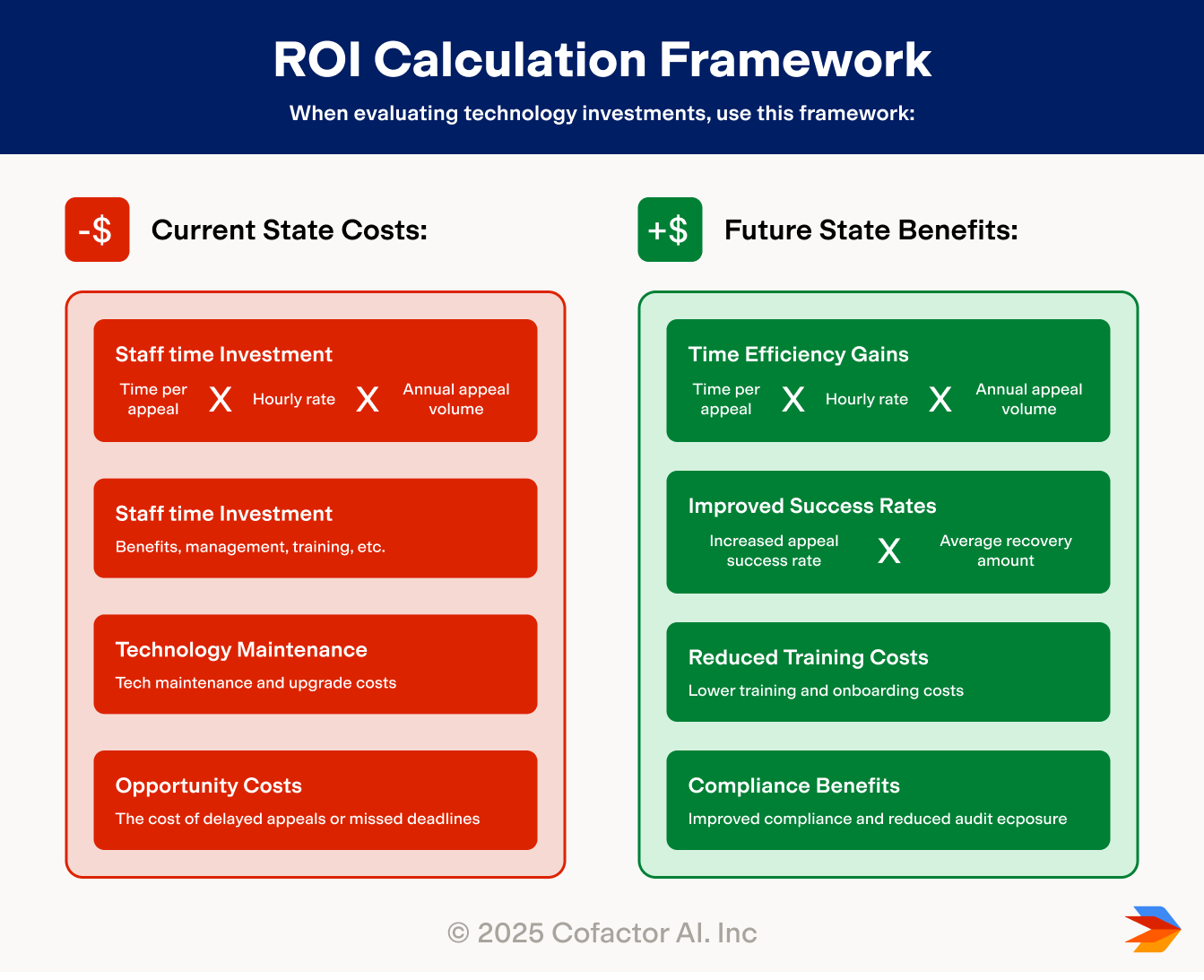
Implementation Considerations: Based on client implementations, expect an 8–12 week integration timeline for full EHR integration, 2–3 weeks of staff training for full adoption, 3–6 months for ROI break-even, and dedicated customer success management for ongoing support.
Your new AI-powered processes will generate unprecedented insights into payer behavior.
Payer Scorecards for Contract Negotiations: Track denial rates by payer, appeal overturn rates, time to adjudication, and policy consistency. Progressive health systems are leveraging appeal outcome data to demonstrate systematic payer behavior patterns, with some achieving contract amendments that reduce unnecessary denials by up to 40%.
Documentation Standards Alignment: Identify payer-specific documentation preferences, seasonal denial patterns, and policy interpretation variations.
Strategic Contract Amendments: Focus negotiations on extended appeal timeframes, burden of proof clauses, audit limitation provisions, and technology integration requirements.
90-Day Quick-Start Plan: Month 1 covers current state analysis and stakeholder alignment across CDI, HIM, UR, and Case Management. Month 2 focuses on workflow redesign and staff development. Month 3 covers technology evaluation, selection, and implementation kickoff.
6-Month Strategic Transformation: Months 1–2 build the foundation with denial pattern analysis and governance structure. Months 3–4 deploy the AI-powered appeal platform and integrate with EHR and billing systems. Months 5–6 optimize processes, expand technology use, and negotiate contract improvements.
Annual Strategic Development: Q1 focuses on advanced analytics and payer scorecards. Q2 expands process automation. Q3 emphasizes strategic payer engagement and contract renegotiation. Q4 evaluates emerging technologies and plans for the year ahead.
3-Year Vision: Year 1 targets operational excellence and top-quartile appeal success rates. Year 2 builds strategic advantage through data-driven payer positioning. Year 3 establishes industry leadership through shared best practices and sustainable competitive advantages.
The new reality of AI-powered audits demands a strategic response. Organizations that continue fighting this battle with manual processes will watch their competitive position erode, while those implementing modern workflows establish sustainable advantages.
Cofactor's AI-powered platform addresses every challenge outlined in this guide: smart prioritization that automatically flags your highest-value DRG downgrades, evidence-based appeals built in minutes incorporating payer policies and clinical guidelines, cross-department integration with your EMR and existing workflows, performance analytics for data-driven decisions, and proven ROI with customers achieving 80–90% time savings and 3–4x appeal volume capacity with existing staff.
The new reality of AI-powered audits is here. Organizations that prepare now will not only survive the increased scrutiny, they'll use it as a competitive advantage to outperform their peers.

DRG 871 sepsis downgrades represent 70% of preventable hospital revenue loss. This guide reveals the root causes, from EMR gaps to training deficits, plus an implementation roadmap covering order sets, pre-bill reviews, and KPI tracking.
X min read
Sepsis-related DRG downgrades are among the most financially damaging and preventable forms of revenue leakage hospitals face. When payers retrospectively challenge sepsis diagnoses and downgrade them to simple infections or pneumonia, the financial hit is immediate: $3,000 to $7,000 lost per case, and over $15,000 for more complex claims. But the impact goes deeper. These downgrades reduce your Case Mix Index (CMI), lowering future reimbursement and skewing your hospital's reported acuity.
Recent industry data reveals that DRG 871 (Septicemia or Severe Sepsis without MV >96 hours with MCC) was Medicare's most-billed DRG in 2019, totaling 581,000 stays and $7.4 billion in payments. This high volume has made it a prime target for payer scrutiny, with Medicare Advantage claim denials increasing by 55.7% between 2022 and 2023. But these national statistics only tell part of the story.
At Cofactor, we've conducted extensive analysis across our hospital partners' actual denial data, processing thousands of complex denials to understand not just the scale of the problem, but its root causes. Our proprietary analysis reveals a striking concentration: 62% of all DRG downgrades we process are DRG 871, with another 8% being DRG 720 (Other Infections and Parasitic Diseases with MCC/CC). Finding that 70% of preventable revenue loss that we process concentrates in sepsis-related cases transforms a seemingly overwhelming challenge into a focused opportunity. In this guide, we cover the patterns we've identified across multiple health systems and translate them into actionable strategies that any hospital can implement. Improving sepsis documentation can prevent the majority of these losses before they occur.
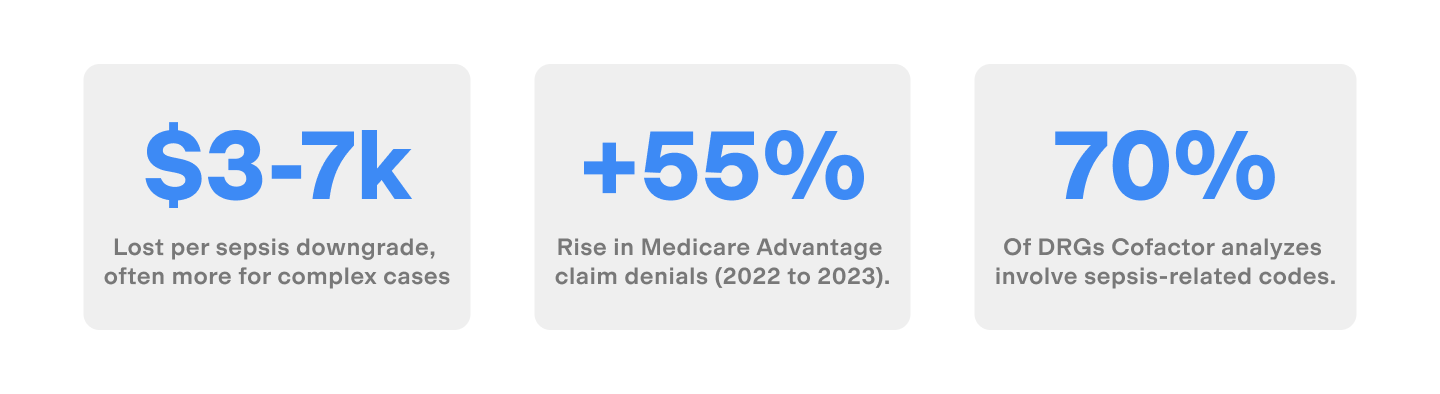
DRG 871 represents cases where patients have sepsis with major complications but don't require extended mechanical ventilation. DRG 720 captures other severe infections with systemic impact. Both are high-weight DRGs that payers aggressively target for downgrades to lower-acuity codes such as UTI (DRG 689) or pneumonia (DRG 193), which can reduce reimbursement by thousands of dollars per case.
The financial damage extends beyond individual claims. Repeated downgrades lower your Case Mix Index (CMI), signaling to regulators that your hospital serves a less complex patient population. This cascades into reduced prospective payments, skewed quality metrics, and diminished negotiating power with payers, a vicious cycle that compounds over time.
The core challenge stems from a growing disconnect between clinical decision-making and payer expectations. Physicians diagnose sepsis based on clinical judgment, including patient deterioration, suspected infection, and signs of organ dysfunction. In contrast, payers increasingly require strict adherence to structured criteria such as Sepsis-3, which depends on documented increases in SOFA scores of two points or more. This means if SOFA scores or organ dysfunction labs aren't explicitly charted, payers will reject the diagnosis, even when the case clearly meets the definition of sepsis. Programs from UnitedHealthcare, Optum, and other major insurers now review these DRGs aggressively, turning a common and appropriate diagnosis into one of the highest-risk billing categories in inpatient care.
Cofactor's comprehensive analysis system reviews the full denial lifecycle from denial letters to medical records and appeals to identify the underlying drivers of revenue loss. Across thousands of DRG 871 and DRG 720 cases, we've identified five recurring failure points:
Clinicians often document "sepsis" or "respiratory failure" in free text without structured data or scoring to back it up. Payers dismiss these notes as subjective.
The absence of required objective data, including labs, vitals, and flowsheets, leaves high-acuity codes vulnerable to challenge, as payers demand quantifiable evidence rather than clinical assessment.
CDI and coding teams often assign high-weight DRG codes for sepsis, respiratory failure, and AKI without querying for missing documentation elements, creating a false sense of security that crumbles under audit.
Both clinicians and coders frequently lack awareness of payer-specific medical necessity criteria, particularly Sepsis-3 requirements and DRG audit rules, operating in a knowledge vacuum that guarantees future denials.
Hospitals often lack a pre-bill huddle or standardized review for high-risk DRGs, so preventable documentation gaps proceed unchecked to billing.
What's Missing: SOFA or qSOFA scores, lactate trends, platelet count, bilirubin, creatinine, Glasgow Coma Scale (GCS), P/F ratio, or respiratory involvement data.
Why It's Denied: Payers reject the sepsis diagnosis when organ dysfunction is not clearly documented. Even when clinical signs are present, missing trending data (like rising lactate) or neurological scores (such as GCS) leave the case vulnerable. Most critically, the lack of trending data showing progression allows payers to recharacterize acute deterioration as chronic baseline conditions.
What's Missing: ABG/VBG values, FiO₂, PEEP, SpO₂ < 91% or PaO₂ < 60 mm Hg, P/F ratio, documentation of acute onset vs. chronic baseline.
Why It's Denied: When respiratory failure lacks gas exchange data or ventilator settings, payers refuse to acknowledge respiratory compromise regardless of clinical presentation. The missing documentation creates plausible deniability for payers to downgrade severe respiratory distress to simple shortness of breath. The failure to clearly indicate acute onset versus chronic baseline allows payers to recharacterize new respiratory failure as longstanding COPD.
What's Missing: Baseline creatinine, post-resuscitation labs, urine output in mL/kg/hr, KDIGO staging criteria.
Why It's Denied: AKI denials exploit documentation gaps that make acute deterioration appear chronic. Without a documented baseline creatinine or urine output trends, payers argue that kidney dysfunction was either chronic or nonspecific. The absence of KDIGO staging criteria allows payers to dismiss even severe AKI as simple dehydration or chronic kidney disease.
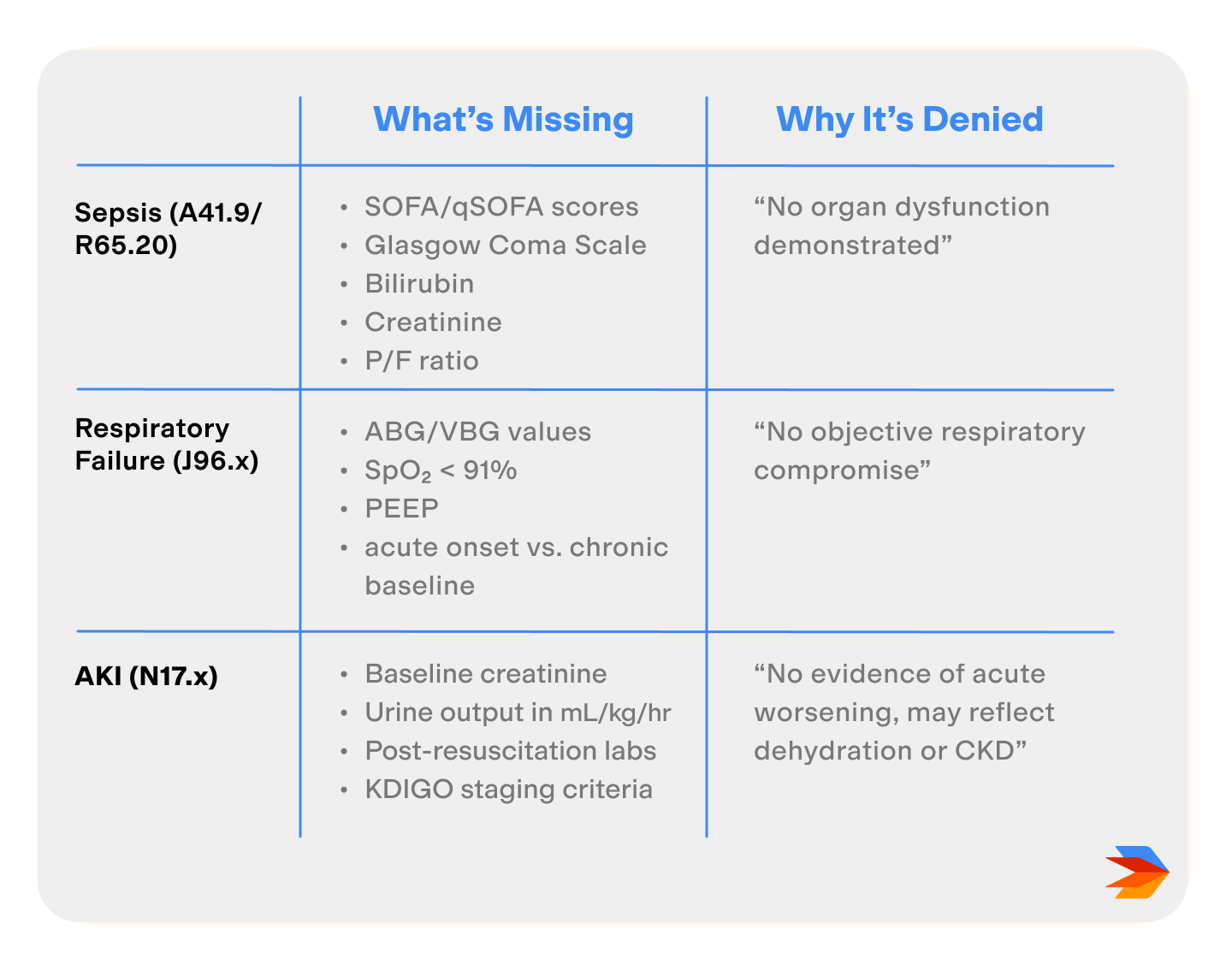
Our analysis uncovered critical systemic failures that perpetuate documentation deficiencies:
Most EMRs lack basic safeguards needed to capture payer-required elements.
Clinical teams operate without visibility into the documentation rules payers use to audit them.
Denial prevention is reactive rather than proactive in most organizations.
Documentation standards evolve quickly, but training often lags behind.
Based on our findings, here's your comprehensive implementation framework:
Technology and Tools:
Process Enhancement:
Education and Training:
Monitoring and Accountability:
As an RCM Director, your success depends on translating these insights into organizational action. Start by quantifying the opportunity: if 70% of your downgrades are sepsis-related at $5,000 average loss, even 100 annual downgrades represent $350,000 in direct losses before considering CMI impact.
Building Executive Buy-In: Present a data-driven business case showing current sepsis downgrade volume and financial impact, projected 50% reduction achievable within 6 months, required investment in technology and resources, and expected ROI within the first year.
Creating Your Coalition: Form a Sepsis Documentation Excellence Team, including a hospitalist champion (clinical credibility and peer influence), CDI manager (process expertise and query management), IT analyst (EMR optimization and reporting), finance representative (ROI tracking and executive updates), and quality leader (connecting documentation to outcomes).
Implementation Strategy:
Payers have systematized their audit process, it's time hospitals systematize their defense. Cofactor's data proves that sepsis-related downgrades are not inevitable. They're the predictable result of misaligned workflows and documentation gaps that you can fix.
The data is clear: 70% of your DRG downgrade risk concentrates in sepsis-related denials. This concentration represents both your greatest vulnerability and your biggest opportunity.
Your next steps:
Let Cofactor help you move from denial reaction to documentation precision.
Clinical documentation improvement AI increases query response rates, reduces denial rates, and optimizes Case Mix Index at scale. Discover implementation strategies, essential KPIs, and proven tactics to move CDI from reactive chart review to proactive revenue protection.
X min read
The stakes have never been higher for healthcare revenue cycle management. Clinical documentation improvement (CDI) programs can unlock thousands in unrealized revenue per corrected inpatient claim, according to recent industry analysis, while external audit volumes more than doubled in 2024 over 2023, with total at-risk dollars increasing fivefold to $11.2 million (IKS HealthMedLearn Publishing). As the healthcare landscape grows increasingly complex, artificial intelligence is emerging as the transformative solution that CDI professionals have been waiting for—one that can finally turn the tide on rising denial rates and optimize Diagnosis-Related Groups (DRGs) at scale.
The numbers paint a sobering picture of today's healthcare financial reality. Healthcare.gov plans denied nearly 1 in 5 in-network claims in 2023, with denial rates varying dramatically across insurers—from as low as 1% to as high as 54% in some states KFFHealthcare Payers. Even more concerning, coding-related denials surged by more than 125% in 2024, while medical necessity-related denials increased by 75 percent for outpatient claims and 140% for inpatient claims MedLearn PublishingMedLearn Publishing.
What makes these statistics particularly alarming is that many of these denials could be prevented. The root cause often lies in documentation gaps that occur during the patient's care journey, gaps that AI-powered CDI solutions are uniquely positioned to identify and address before claims ever leave the hospital.
The global CDI market, valued at $4.52 billion in 2023 and expected to reach $10.44 billion by 2034, demonstrates the growing recognition that traditional manual processes simply cannot keep pace with today's documentation demands (Precedence Research). Healthcare leaders are increasingly turning to AI not just as a productivity tool, but as a strategic weapon in the fight against revenue leakage.
Understanding the metrics that define successful CDI programs is crucial for measuring AI implementation effectiveness:
Case Mix Index (CMI) Optimization: AI-powered systems can analyze patterns across thousands of cases to identify opportunities for CMI improvement, ensuring DRG assignments accurately reflect patient complexity and resource utilization.
Query Response Rate Excellence: AI can streamline the query process by generating more targeted, clinically relevant queries closer to the time of care that physicians are more likely to complete promptly.
DRG Accuracy at Scale: Machine learning algorithms can identify discrepancies between clinical documentation and DRG assignments faster and more consistently than manual review processes.
Proactive Revenue Protection: By analyzing historical patterns, AI can predict which cases are at highest risk for denial, enabling preemptive documentation improvements.
The transformation happening in CDI isn't theoretical, it's delivering measurable results across healthcare organizations. Consider the workflow evolution that AI enables:
Traditional CDI Process: A CDI specialist reviews 8–12 charts per day, manually searching through documentation, crafting queries, and following up with physicians, a process that can take 30–45 minutes per case.
AI-Enhanced CDI Process: The same specialist reviews 15–20 charts per day, with AI pre-analyzing documentation, flagging specific gaps, and even drafting initial queries, reducing review time to 15–20 minutes per case while improving accuracy.
This isn't just about efficiency gains. It's about enabling CDI professionals to focus on the complex clinical decision-making and physician engagement that truly requires human expertise, while AI handles the time-consuming analytical work.
The most sophisticated AI-powered CDI programs don't just improve documentation, they prevent denials before they occur. By analyzing patterns across claims data, payer policies, and historical denial reasons, these systems can flag potential issues during the patient's stay, not months later during claims processing.
Modern AI systems integrate directly with EHR workflows, providing immediate feedback to clinicians during documentation entry. This proactive approach addresses documentation gaps at the point of care, when clinical details are freshest in the provider's mind.
AI excels at pattern recognition across vast datasets. By analyzing denied claims alongside successful appeals, these systems can identify subtle documentation patterns that human reviewers might miss, revealing the specific language and clinical details that resonate with different payers.
Healthcare organizations implementing AI-driven CDI solutions are reporting transformative results:
As the broader healthcare AI market is projected to reach $3,680.47 billion by 2034 Artificial Intelligence Skyrocketing, Shaking the Market with $3,680.47 Bn by 2034, CDI professionals who embrace AI-powered solutions today will be positioned as strategic leaders in their organizations tomorrow.
The question isn't whether AI will transform CDI, it's whether your organization will lead or follow this transformation. Healthcare systems that invest in AI-powered CDI solutions now are not just improving their current financial performance; they're building the foundation for sustainable revenue optimization in an increasingly complex reimbursement landscape.
The convergence of AI technology with clinical documentation improvement represents more than an operational upgrade, it's a fundamental shift toward proactive, data-driven revenue cycle management. As denial rates continue climbing and regulatory complexity increases, hospitals that strategically implement AI-powered CDI solutions will gain decisive competitive advantages through improved financial performance, enhanced documentation quality, and optimized resource utilization.
The future of CDI is here, powered by artificial intelligence. The question is: will you be part of it?

Clinical Documentation Improvement teams have mastered denial prevention through real-time collaboration and concurrent review. Discover how to transform your denial management program using CDI best practices.
X min read
Healthcare organizations are facing an unprecedented surge in claim denials, with 77% of providers reporting increased denial rates from 2022 to 2024 (RevCycle, 2024). The financial impact is staggering—about 9% of hospital claims denied, averaging $262 billion per year (HFMA, 2022). As denials management teams struggle to keep pace with this mounting challenge, there's a powerful model for success hiding in plain sight: Clinical Documentation Improvement (CDI) teams have mastered collaborative workflows that prevent problems before they occur.
The data reveals a critical insight for denial management: 76% of denials are driven by missing, incomplete or inaccurate data Denial Management Strategies for 2025: Trends & Best Practices - RevCycle (RevCycle, 2024). This statistic points directly to the importance of clinical integrity documentation and denial workflows working in harmony. CDI teams have long understood that quality documentation forms the foundation of accurate coding and successful reimbursement.
Before diving into CDI best practices, denials management teams should track these essential metrics:
CDI teams have developed sophisticated workflows that address documentation issues before they become denials. Their approach offers valuable lessons for denial management teams seeking to shift from reactive to proactive strategies.
CDI specialists collaborate with physicians to enable complete, accurate clinical documentation supporting medical necessity guidelines (IKS Health, 2025). This real-time partnership ensures that clinical documentation captures the full complexity of patient care while meeting payer requirements.
CDI teams achieve this through:
The success of CDI programs stems from their ability to bridge silos between clinical and administrative teams. 86% of respondents blame a lack of workplace collaboration or ineffective communication for workplace failures (Runn, 2024). CDI teams overcome this challenge by creating structured collaboration frameworks.
Effective CDI teams integrate clinical staff who understand patient care complexities, coding professionals who translate documentation into billable services, revenue cycle experts who understand payer requirements, and quality improvement specialists who track outcomes.
Rather than waiting for denials to occur, implement review processes that mirror CDI's concurrent approach:
Collaborative process development involves partnering with practice and service line leaders to devise processes that tackle root causes directly and foster collaboration on resolving denials and payment disputes (BDO, 2024).
Structure your teams to include denial prevention specialists who analyze patterns and identify systemic issues, clinical liaisons who can interpret medical necessity requirements, payer relations experts who understand specific payer policies, and data analysts who track metrics and identify trends.
CDI teams excel at physician education, and denial management teams should adopt similar approaches:
45% said their organization planned to do [invest in claims management technology] within the next six months Claims Denials and Appeals in ACA Marketplace Plans in 2021 | KFF (HFMA, 2025). Like CDI teams who use technology to identify documentation gaps, denial management teams should employ:
The most effective CDI programs require close collaboration between clinicians, coders, and administrative teams while leveraging technology-driven efficiency and innovation Breaking down claim denial rates by healthcare payer | TechTarget (IKS Health, 2025). AI tools are now helping CDI teams identify documentation gaps more efficiently, a capability that denial management teams can leverage for pre-submission reviews.
Healthcare providers are grappling with an uptick in claim denials—a trend partly fueled by payers' adoption of artificial intelligence (AI) tools Clinical Documentation Improvement (CDI) Enhances Medical Coding to Maximize Revenue Capture (BDO, 2024). Initial denial rates as a percentage of claim value jumped from 10.15% in 2020 to 11.99% by the end of Q3 2023 Hospitals reached steadier ground financially as they moved into 2024 | HFMA (HFMA, 2025). Organizations are moving from reactive denial management to proactive prevention strategies, mirroring CDI's concurrent review approach.
Creating shared, measurable goals based on industry best practices helps create a culture of teamwork with an aligned vision that encourages collaborative decision-making and problem-solving (MedCity News, 2024). Organizations are breaking down silos between CDI, coding, and denial management teams.
Providers spent nearly $20 billion in 2022 pursuing delays and denials across all payer types HFMA Claim Integrity Task Force seeks to standardize denial metrics, with about $10.6 billion "wasted arguing over claims that should have been paid at the time of submission" HFMA Claim Integrity Task Force seeks to standardize denial metrics (Fierce Healthcare, 2024). This highlights the critical need for proactive denial prevention strategies that CDI teams have already mastered.
To track the effectiveness of CDI-inspired denial workflows, monitor these KPIs:
The lessons from CDI teams point to a clear conclusion: success in denial management requires seamless collaboration, proactive intervention, and intelligent automation. This is where Cofactor's AI-powered denial management platform bridges the gap between CDI excellence and denial prevention.
Cofactor's platform dramatically reduces the time required to create appeal letters, from hours to just 10–15 minutes per appeal. This efficiency allows denial management teams to process significantly more appeals while maintaining the quality standards that CDI teams apply to documentation improvement.
Just as CDI teams identify documentation gaps before they impact coding, Cofactor's predictive analytics flag high-risk claims before submission. Our proprietary scoring system prioritizes denials based on financial impact, appeal deadlines, and likelihood of overturn, ensuring teams focus efforts where they'll have the greatest impact.
Cofactor breaks down silos by automatically retrieving relevant clinical documentation through FHIR integration, analyzing payer policies, and generating comprehensive appeals that incorporate all necessary evidence. This creates a unified workflow that connects clinical documentation, coding standards, and payer requirements, exactly the type of integration that makes CDI teams successful.
With denial rates climbing and 54.3% of denials from private payers ultimately overturned and paid (Fierce Healthcare, 2024), organizations using Cofactor see immediate financial benefits. By reducing appeal creation time by 80–90% and improving appeal quality through AI-powered evidence analysis, healthcare organizations can expect significant returns on investment within the first year of implementation.
The path forward is clear: denial management teams that adopt CDI-inspired collaborative workflows, supported by intelligent automation like Cofactor, will be best positioned to tackle the growing challenge of claim denials. By learning from CDI's success in proactive documentation improvement and combining it with advanced AI capabilities, healthcare organizations can transform their denial management from a reactive cost center into a proactive revenue protection strategy.
The most successful organizations don't just manage denials, they prevent them. By adopting the collaborative, proactive, and data-driven approaches that make CDI teams successful, your denial management program can achieve similar transformative results.

86% of claim denials are avoidable, yet providers spend $19.7B annually fighting policy-related denials. Learn how to build a payer policy database that tracks changes, enables real-time claim validation, and reduces denials.
X min read
Healthcare claim denials reached an alarming 15% of all claims submitted to private payers in 2024, with providers spending an estimated $19.7 billion annually fighting denied claims (Premier Inc, 2024). More concerning is that 77% of providers report payer policy changes are occurring more frequently than in previous years, making it increasingly difficult to keep up with evolving requirements.
For hospital administrators, establishing a robust payer policy database isn't just a revenue cycle optimization, it's a financial survival strategy. This comprehensive guide provides actionable steps to build and maintain a payer policy management system that reduces denials, accelerates reimbursements, and protects your bottom line.
Before implementing your payer policy database, it's crucial to establish baseline metrics that will measure success:
Claim Denial Rate: This metric tracks the percentage of claims initially denied by each payer, varying significantly between Medicare Advantage and commercial payers.
Policy Change Response Time: The average time between payer policy updates and internal system implementation, a critical factor in preventing denials.
Clean Claim Rate: The percentage of claims submitted without errors requiring rework, directly impacted by policy adherence.
Appeal Overturn Rate: This measures the success rate of challenging denied claims with proper documentation.
Days in Accounts Receivable (AR): The average time to collect payment, significantly impacted by policy compliance issues.
Begin by categorizing your denials based on payer policy violations. Becker's Hospital Review indicates that 86% of denials are avoidable, with many stemming from policy non-compliance.
Create denial tracking workflows that identify:
Establish monthly reporting that correlates denial patterns with policy changes. Most hospitals discover that policy-related denials cluster around specific timeframes when payers implement new requirements without adequate provider notification.
Implement automated alerts that flag unusual denial patterns, particularly those related to recently updated policies. This proactive approach helps identify policy gaps before they impact larger claim volumes.
Create a dedicated payer policy management team that includes:
Establish regular touchpoints between your policy team and key departments:
Design escalation protocols for policy conflicts or ambiguous requirements that require payer clarification.
Your payer policy database should integrate with existing systems while maintaining data integrity:
Policy Repository System: Centralized storage for all payer policies, organized by payer, product line, and effective dates. Include search functionality that allows staff to quickly locate relevant policies by procedure code, diagnosis, or clinical scenario.
Automated Policy Updates: Establish feeds from major payers that automatically update your database when policies change. About 50% of providers report denial rates increased due to policy change tracking failures (ACDIS, 2023).
Integration Touchpoints: Connect your policy database with:
Implement intelligent systems that learn from your organization's policy compliance patterns:
Develop training curricula tailored to how different roles interact with payer policies:
Clinical Staff Training: Focus on documentation requirements, medical necessity criteria, and coverage limitations. Create quick-reference guides for common procedures and their policy requirements.
Revenue Cycle Staff Training: Emphasize policy-specific billing requirements, modifier usage, and appeal strategies. Include hands-on practice with your policy database tools.
Case Management Training: Concentrate on discharge planning requirements, level of care criteria, and coverage duration limits.
Establish ongoing training that addresses:
Create feedback loops that capture staff insights on policy interpretation challenges, using this input to refine training programs and policy documentation.
Monitor these metrics to assess your policy database effectiveness:
Policy Compliance Rate: Track the percentage of claims that meet policy requirements on first submission, targeting 95% or higher.
Policy Change Implementation Speed: Measure time from policy notification to system implementation, aiming for same-day updates for critical changes.
Denial Reduction by Policy Category: Track month-over-month improvements in policy-related denials.
Staff Policy Query Resolution Time: Monitor how quickly staff can find and apply policy information, targeting under 2 minutes for routine queries.
Implement monthly scorecards that identify:
Use this data to prioritize policy database enhancements and training investments.
Healthcare organizations are increasingly implementing artificial intelligence to manage payer policy complexity. Healthcare Revenue Cycle Management market research indicates the global RCM market will grow from $152.14 billion in 2024 to $453.47 billion by 2034, with AI-driven policy management as a key growth driver.
Leading health systems are deploying machine learning algorithms that automatically scan payer websites for policy updates, cross-reference changes with existing claims, and generate impact assessments for revenue cycle teams.
Modern policy databases now include real-time validation that checks claims against current policies before submission, preventing denials at the source rather than managing them after occurrence.
Healthcare organizations are leveraging predictive analytics to anticipate policy changes before they're announced. By analyzing payer behavior patterns, regulatory trends, and industry shifts, these systems help providers prepare for policy modifications proactively.
Emerging technologies are being explored for policy database integrity, ensuring that policy documents maintain accuracy and creating immutable records of payer requirements that can be referenced during appeals or audits.
Managing payer policies manually is no longer sustainable in today's complex healthcare environment. Cofactor's AI-powered denials management platform directly addresses the challenges hospital administrators face with payer policy compliance.
Cofactor's platform automatically incorporates payer-specific medical policies, clinical criteria, and administrative requirements into comprehensive appeal letters. When policy-related denials occur, our system analyzes the specific policy violation and generates evidence-based appeals that reference the exact policy requirements, eliminating hours of manual research and documentation.
Our AI analyzes payer policies alongside clinical documentation to identify the strongest evidence supporting your appeal, ensuring that policy-specific requirements are met while minimizing the time your staff spends crafting individual responses.
Cofactor's advanced prioritization algorithm incorporates payer policy changes into denial risk assessment. Our system continuously monitors policy updates and identifies which of your pending claims might be affected by new requirements, allowing proactive intervention before denials occur.
By analyzing patterns in payer policy enforcement, Cofactor helps predict which policies are most likely to result in denials, enabling your team to focus documentation efforts where they'll have the greatest impact on denial prevention.
Our platform integrates seamlessly with your existing systems while maintaining a comprehensive database of payer policies. Rather than managing multiple policy sources, Cofactor provides a unified view of policy requirements directly within your appeal workflow, reducing the time required to create effective appeals from hours to minutes.
The system tracks policy-specific appeal success rates, providing insights into which policy arguments are most effective with different payers, continuously improving your appeal strategy based on real-world outcomes.
Hospitals using Cofactor's platform report significant improvements in policy-related denial management. By automating the evidence gathering and appeal generation process, organizations can handle 400% more appeals with existing staff while achieving higher overturn rates through comprehensive policy-compliant documentation.
The platform's ability to rapidly generate policy-specific appeals means that time-sensitive policy deadlines are no longer missed, protecting revenue that would otherwise be lost to administrative delays. This combination of increased efficiency and improved outcomes delivers measurable ROI within the first quarter of implementation.
A robust payer policy database is essential for modern healthcare revenue cycle management. Success requires:
Strategic Foundation:
Technology Excellence:
People and Process:
Measurable Outcomes:
The investment in a comprehensive payer policy database pays dividends through reduced denials, faster reimbursements, and protected revenue, making it one of the most strategic initiatives hospital administrators can undertake.
Ready to transform your payer policy management strategy? Cofactor's AI-powered platform helps hospital administrators build robust policy compliance systems that reduce denials, accelerate reimbursements, and protect revenue.

Aetna's new Medicare Advantage policy will approve inpatient admissions but pay many at observation rates with no appeal rights. Revenue cycle leaders need immediate strategies to catch what won't show up in standard denial workflows.
X min read
The expansion of the Two-Midnight Rule into Medicare Advantage plans was supposed to be a win for hospitals. When CMS mandated (in 42 CFR 422.101) that MA plans follow the same inpatient admission criteria as traditional Medicare, revenue cycle leaders were cautiously optimistic. The rule promised to level the playing field: if the stay spans two midnights, or is expected to, it qualifies as inpatient.
And for a brief moment, it worked. Inpatient admissions rose 3.9% year-over-year. Hospitals saw long-overdue reimbursement for the care they were already providing. Finance leaders across the country noted the shift. But now, Aetna may have found a way around it.
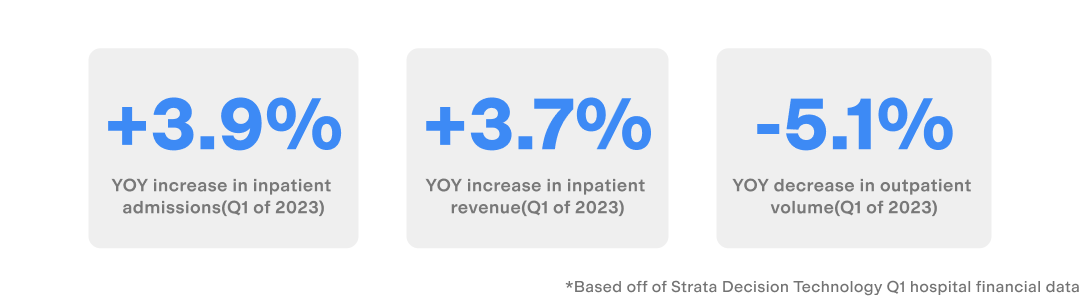
On November 15, 2025, Aetna automatically approved inpatient admissions for emergent or urgent Medicare Advantage cases that span at least one midnight. That might sound like progress: no more front-end denials and no more endless peer-to-peer calls.
But there's a catch: if the case doesn't meet the Milliman Care Guidelines (MCG) for inpatient criteria, it'll still be automatically approved, but only paid at observation-level rates.
And perhaps most importantly, there's no formal denial to appeal. No peer-to-peer. No notification. Just a payment quietly marked "complete" on your 835. The underpayment will simply appear on your remittance advice, and the billing system will treat the shortfall as a "contractual adjustment," as if the inpatient claim was fully reimbursed.
In other words, the revenue loss won't even trigger your standard denial workflows. It will silently undermine reimbursement without raising red flags.
Aetna frames this as a move toward efficiency: avoiding delays, reducing provider burden, and removing the need to rebill as observation. But functionally, it enables plans to approve admissions while paying less, all while sidestepping the intent of the Two-Midnight Rule: protecting hospitals from inappropriate denials and revenue leakage.
This approach replaces transparency and due process with automation and opacity. It takes the fight out of the front end and buries the underpayment in your back-end reporting.
For finance and revenue leaders, this is a significant concern. The difference between full inpatient reimbursement and observation rates is not trivial. And when that gap is recorded as a contractual adjustment, it won't surface in typical denial or variance reporting. You'll only see it if you're actively reconciling expected versus actual payment at the claim level.
This concern is amplified by the broader financial pressures facing hospitals today. With many facilities at risk of closure or service reduction, payment policies that erode reimbursement for legitimate inpatient care could have far-reaching consequences, not just for revenue cycle performance, but for access to care and quality outcomes across the board.
While this policy currently only applies to Aetna's Medicare Advantage and Special Needs Plans, if other MA plans adopt similar approaches, the impact will be felt nationwide, as 1.3% of inpatient revenue could vanish. Roughly 17% of MA inpatient claims are initially denied, and while 60% of those are currently overturned, that revenue will no longer be easily recovered. What was supposed to protect hospital reimbursement becomes a framework for systematic underpayment.
Key Financial Risks:
And most importantly, don't assume approved equals appropriate. The absence of a denial doesn't mean the payment is correct.
This policy represents a significant shift in how MA plans may approach payment, even when following CMS regulations on admission criteria. The key to protecting revenue is proactive preparation.
This new payment approach doesn't come with a press release or a denial letter. It shows up quietly on your 835, marked "paid in full," but falling far short of what's owed. The time to prepare and protect your revenue is now, before this approach becomes widespread.
Success in this environment requires:
The healthcare reimbursement landscape continues to evolve, and revenue cycle leaders must adapt their strategies to protect legitimate reimbursement while maintaining focus on patient care quality.

Stop losing sepsis, respiratory failure, and MCC denials. This playbook reveals policy-first appeal strategies that win across major payers, with condition-specific evidence checklists and systematic workflows for turning manual appeals into scalable revenue recovery.
X min read
Denials are growing faster than most RCM teams can respond. Payers are scaling AI-powered reviews across evolving policy frameworks. Yet many hospitals are still fighting them manually.
This is beyond being inefficient. It's ultimately unsustainable. When payers can deny in seconds but your team needs days to appeal, you're fighting an uphill battle and leaving revenue on the table.
We analyzed countless successful complex denial overturns across top payers (Aetna, Anthem, UnitedHealthcare, Medical Mutual, CareSource, Molina, The Health Plan, Humana, and others) and distilled down proven patterns, payer-specific nuances, and condition-specific evidence checklists to speed up submission and improve overturn rates while complying with each payer's procedural rules.
Our automated, policy-aware appeal generation consistently produced outcomes that manual workflows struggle to match. While speed matters, maintaining precision at scale is what drives results. Overturn rates vary significantly based on case selectivity: hospitals that appeal only high-confidence denials with either workflow may see higher baseline rates, while those appealing broader portfolios typically fall within industry averages.
These represent significant revenue recovery opportunities. The winning structure pairs the denial rationale verbatim against a policy quote plus chart proof.
Critical Policies: ICD-10-CM I.C.1.d.1.a (A41.9 valid even when cultures negative), I.C.1.d.1.b, Sepsis-3, CMS SEP-1, Surviving Sepsis hour-1 bundle.
Evidence That Wins: SIRS criteria or qSOFA scores, SOFA trends showing organ dysfunction, lactate/procalcitonin values with timestamps, antibiotic timing within the hour-1 bundle, source control documentation with procedure codes.
Key Insight: Payers accept culture-negative sepsis when you can demonstrate SIRS criteria, organ dysfunction scores, and adherence to the sepsis bundle timing. Documentation of the bundle matters as much as the diagnosis itself.
Critical Policies: ICD-10-CM I.C.10.b.1, Aetna acute respiratory failure thresholds, Berlin ARDS criteria, ATS/ERS guidelines.
Evidence That Wins: ABG strips showing PaO₂ <60 or SpO₂ ≤90%, pulse-ox trend with nadir values, intubation note with ventilator settings (FiO₂, PEEP), ICU admission documentation, critical care time (99291/99292).
Key Insight: The absence of documented gas exchange data is fatal to these appeals. Payers will dismiss clinical impressions of respiratory distress without objective ABG values and ventilator settings. Excludes1 conflicts (like J95.82) don't apply when coded correctly, so cite the specific guideline section.
Common scenarios include rhabdomyolysis vs. COVID-19, SMA dissection/ischemia, and SBO vs. sepsis disputes.
Critical Policies: ICD-10-CM II.A (principal diagnosis definition), II.C (resource-driven sequencing).
Evidence That Wins: Resource consumption charts showing which condition drove care:
Key Insight: Payers explicitly accept II.A/II.C arguments when you demonstrate that your selected principal diagnosis consumed the most resources. Chart the actual interventions with timestamps.
Encephalopathy (G93.41): Requires neuro workup documentation (EEG/LP/CTA), infectious or metabolic etiology, and demonstration of impact on care. Cite ICD-10-CM I.B.14 for multiple coding of acute conditions.
Malnutrition: ASPEN/GLIM criteria require two or more phenotypic plus etiologic criteria, dietitian NFPE with physician co-sign, and proper POA flags.
Suspected Pneumonia MCC: ICD-10-CM Section III and AHA Coding Clinic Q4 2017 allow coding when the condition was evaluated and treated. Culture-negative cases are accepted when you show imaging, leukocytosis, and empiric antibiotics.
Winning individual denials requires condition-specific clinical knowledge. Winning consistently requires systematic infrastructure. Here's what separates hospitals with high overturn rates from those stuck at industry average:
Early, Explicit POA Flags. Tag conditions as present on admission immediately: sepsis, pneumonia, malnutrition, bacteremia, AKI, encephalopathy. This prevents payers from arguing the condition developed during the stay.
Coder "Code-to-Note" Sheets. Embed these as exhibits in your appeals. Format: ICD-10/CPT to guideline section to chart line/page reference. This lets reviewers trace every code directly to source documentation in seconds.
Physician Addenda. Secure physician confirmation of: sepsis POA and organ dysfunction specifics (SOFA q-points), critical care minutes with life-threatening management tasks, principal diagnosis rationale and resource utilization, MCC impact with specific terminology like "acute metabolic encephalopathy."
48-Hour Denial Huddles. Cross-functional teams (clinician, CDI, coder, billing, appeals specialist) complete the Denial to Evidence to Policy cross-walk on Day 1, rather than waiting until day 25 of a 30-day window.
Policy Binder + Guideline Library. Maintain organized access to ICD-10 sections, payer policies, and clinical standards (ASPEN/GLIM, KDIGO, Sepsis-3, ACOG, AHA/ACC, ATS/ERS), searchable and immediately available to appeal writers.
Continuous Post-Appeal Debrief. Log what worked. Update templates. Track trends by denial type, payer, DRG, and days to resolution. Share lessons with CDI, coding, and clinicians in 15-minute huddles.
The full implementation guide includes complete templates for denial huddles, policy binders, exhibit organization, and peer-to-peer one-pagers.
Manual workflows often present evidence and policy separately, forcing reviewers to make the connections themselves. Policy-aware automation instead creates an irrefutable chain of proof: what the chart shows, the policy that defines it, and therefore the code, DRG, or service that should be approved. This explicit linkage eliminates reviewer ambiguity across conditions like sepsis, AKI, malnutrition, and encephalopathy.
Payers have systematized their audit process. It's time hospitals systematize their defense. The appeals that win share common infrastructure:
This isn't about fighting harder. It's about fighting smarter with systems that scale.
This post covers the core patterns. The full Denial Overturn Playbook includes detailed payer-specific strategies with appeal windows and procedural requirements, ready-to-use templates for denial huddles, policy binders, peer-to-peer scripts, and coding cross-walks, and implementation checklists for building systematic appeal infrastructure.
Reach out to learn how Cofactor can automate your appeal generation, standardizing quality and shortening review cycles across all payers.
Systematic approaches win. The question is whether you'll build the system yourself or let us automate it for you.
Cofactor partnered with Memorial to bring structure, speed, and visibility to their DRG workflows. What began as a solution for operational backlog quickly became a strategic driver across revenue cycle operations and documentation workflows.
X min read
Memorial Health System (MHS) is a multi-hospital network committed to delivering high-quality patient care. Like many health systems, they faced a growing challenge in managing DRG downgrades and defending complex clinical documentation. Their teams were stretched thin, and the rapid rise in denials made it increasingly difficult to protect earned revenue.
Cofactor partnered with Memorial to bring structure, speed, and visibility to their administrative workflows by embedding an engineer and deploying a single AI agent. What began as a solution for operational backlog quickly became a strategic driver across revenue cycle operations and documentation workflows.
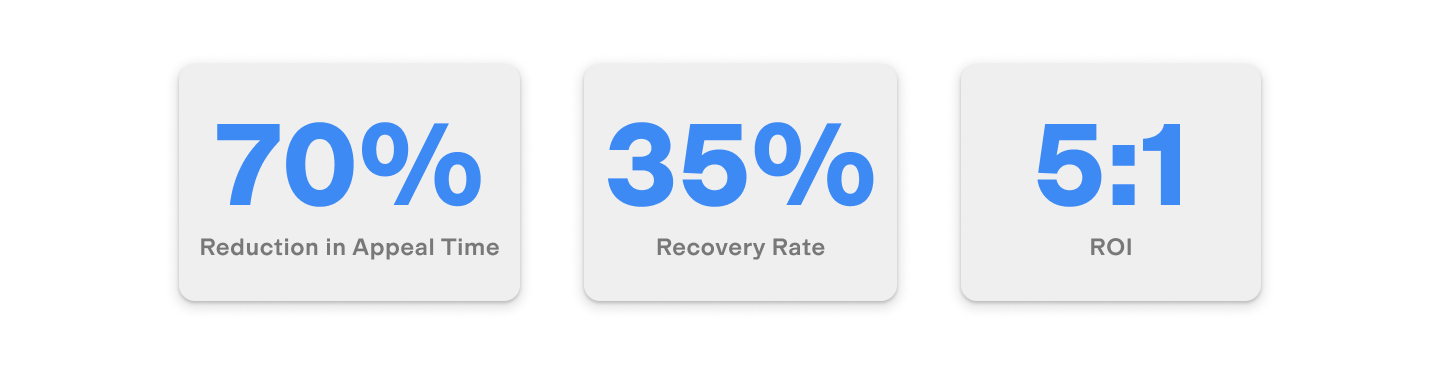
Appeals required ~60+ minutes of manual work per case. At that rate, scaling was impossible. Volume was rising, but capacity was fixed.
MHS teams were receiving more DRG downgrades than they had capacity to appeal. With limited staff and rising volume, they were forced to pick and choose which cases to fight. This meant preventable revenue loss and inconsistent outcomes.
Prior to Cofactor, appeals were handled manually. The team did not have the time or tools to track every case through multi-level appeal processes. Key metrics such as overturn rate, turnaround time, and appeal outcomes were effectively unmeasurable.
Without structured data, Memorial could not routinely identify which DRGs were most vulnerable or which documentation patterns needed reinforcement. This limited both financial recapture and preventive action.
The experienced Memorial team knew what needed to be done. They simply didn't have the bandwidth or infrastructure to do it at scale.
Cofactor deployed a single appeals agent with automated audit, appeal creation, and full-cycle tracking. The goal was not only to reduce workload, but to provide Memorial with the visibility and confidence needed to take control of their DRG performance.
Every case entering the workflow undergoes a complete review of the medical record, coding guidelines, clinical criteria, and payer policies. This ensured every appeal began with a thorough, consistent foundation that previously required extensive manual effort.
The platform automates the mechanical tasks like extracting clinical data from lengthy medical records, assembling structured arguments, and organizing citations. This reduces the cognitive burden on staff and enables MHS to handle significantly higher volumes while maintaining human oversight throughout every case.
Memorial gained end-to-end tracking of every downgrade, every appeal level, and every outcome through real-time dashboards. The platform doesn't just track individual cases but identifies actionable patterns across high-impact appeals like sepsis and respiratory cases, continuously improving its ability to reveal exactly which documentation gaps were driving denials and which payer behaviors needed strategic attention. For the first time, Memorial could quantify their denial landscape and use that intelligence to guide both immediate appeals and long-term prevention strategies.
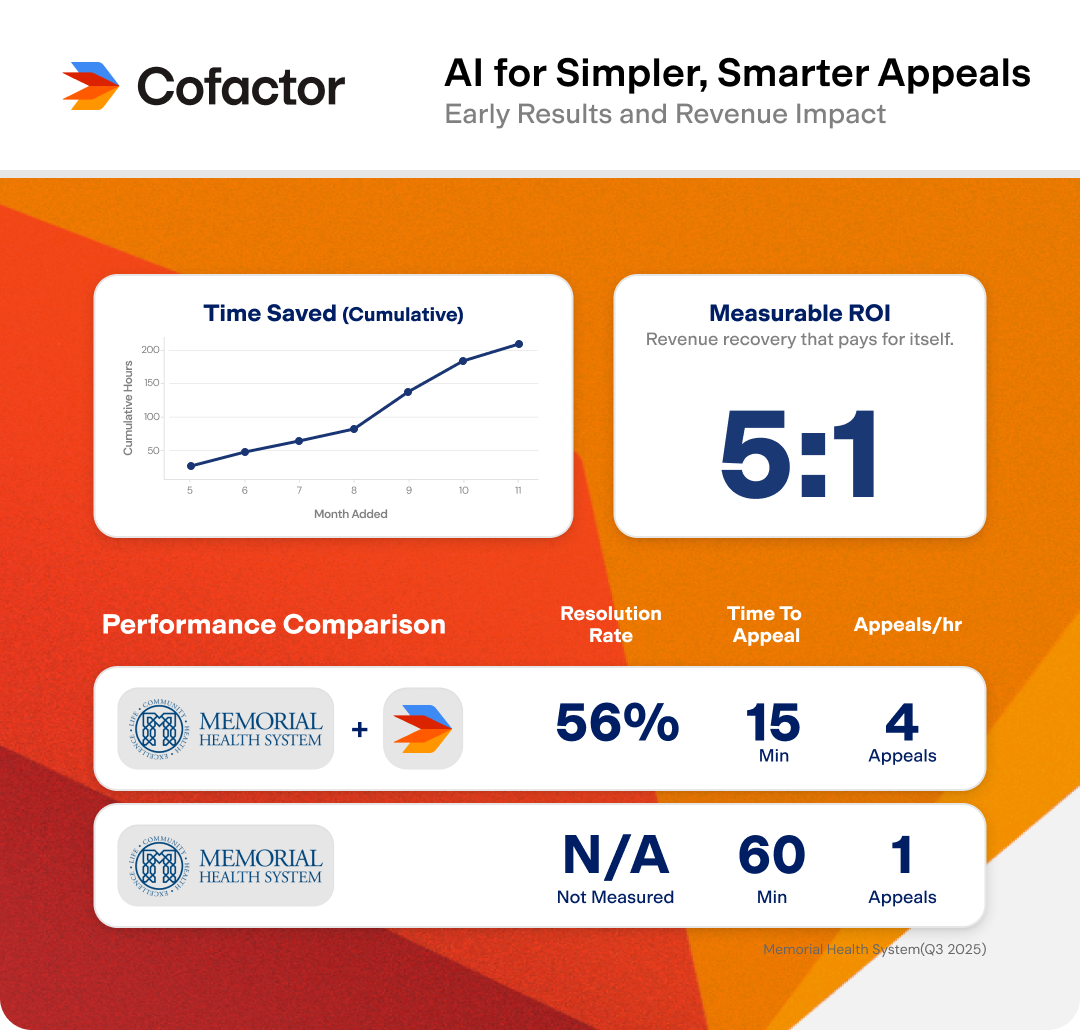
With workflows fully streamlined, Memorial's team went from spending 1 hour per case to just 15–20 minutes, a reduction that provided the operational capacity to appeal everything without adding headcount.
The agent eliminated the tedious, labor-intensive work that consumed hours of staff time per appeal, freeing the team to redirect their expertise from administrative assembly to high-value clinical judgment and strategic prioritization while maintaining rigorous human oversight on every case.
Prior to Cofactor, Memorial couldn't track what they weren't appealing. With only selective appeals being filed, baseline metrics simply didn't exist. Now they have complete transparency into their downgrade performance and can quantify:
With visibility established, the financial impact became measurable. Memorial now appeals every appropriate denial, achieving a 35% overturn rate that significantly exceeds the 17% industry standard. On historically difficult cases like sepsis downgrades, where previous success rates approached zero, Memorial consistently wins appeals backed by comprehensive clinical evidence.
The transformation extends beyond operational efficiency to measurable financial return. Memorial had a 5:1 ROI, eliminating the painful triage decisions that once defined their workflow.
"If we didn't have Cofactor anymore we wouldn't have the manpower to appeal everything we're receiving. We would have to pick and choose which appeals that we're appealing and we would essentially lose that money."
— Sydney Crawford
Beyond recovering lost revenue, the platform enabled strategic prevention. Memorial's newly formed Sepsis Committee utilizes Cofactor's monthly root cause analysis reports to systematically identify documentation gaps and proactively address avoidable downgrades. Rather than simply reacting to denials after the fact, Memorial now has the intelligence infrastructure to prevent revenue leakage before it occurs.
Today, the Cofactor Lab serves as more than a denials management platform for Memorial. The forward-deployed engineering resources continue to expand Memorial's AI roadmap, connecting revenue protection, operational efficiency, and documentation improvement into a single, growing intelligent workflow.
"The ROI was clear almost immediately. We're overturning denials we couldn't win before, including sepsis cases, and our team is working far more efficiently. Beyond just recovering revenue, Cofactor is surfacing root cause insights into what's driving these denials so we can prevent them.
What gives us confidence is knowing every appeal is backed by a complete review of the medical record, coding guidelines, clinical criteria, and payer policies, something we simply couldn't produce manually at scale. We're catching revenue that would have otherwise been left on the table.
Cofactor operates like a true partner. They're responsive, they listen to feedback, and they move quickly to solve problems. It's refreshing to work with a vendor that's actually invested in our success."
— Missy Fleeman, VP of RCM

HIM leaders bridge clinical, coding, and payer knowledge, making them essential to AI success. Learn how this cross-functional role drives ROI.
X min read
The healthcare revenue cycle is undergoing a significant digital shift. AI and automation are increasingly used to address persistent challenges in coding accuracy, denial management, and documentation quality. According to a 2025 HFMA survey, 90% of revenue cycle leaders believe AI will be moderately to extremely effective in improving CDI and coding accuracy. The opportunity is substantial, including faster claim processing, reduced administrative burden, and recovered revenue.
Despite this promise, results vary widely. Some organizations report meaningful improvements, while others struggle to achieve ROI after significant investment. The difference is rarely the technology alone. More often, it comes down to how AI is implemented and who is involved in guiding that implementation.
Many AI initiatives fail because they exclude the professionals best equipped to ensure success. Health information management (HIM) leaders sit at the intersection of clinical documentation, coding operations, and payer requirements. That position makes them critical to determining whether AI improves outcomes or introduces new financial and compliance risk.
There are two main issues that commonly undermine AI performance in revenue cycle operations: First, AI systems trained only on historical data tend to reproduce existing documentation gaps and coding inconsistencies. An AI model trained on incomplete physician notes will generate incomplete codes, simply at a faster pace. Second, many implementations are designed to replace workflows rather than support them, leading to disruption and resistance from the teams expected to use these tools every day. The result is a familiar paradox: the people with the deepest understanding of workflow realities are often excluded from implementation decisions.
Organizations that achieve consistent results take a different approach. They involve HIM professionals as strategic partners in AI implementation rather than positioning them as downstream users adapting to decisions made elsewhere.
HIM professionals operate across clinical documentation, coding accuracy, billing operations, and payer policy requirements. This cross-functional visibility exposes complexities that siloed teams and technology vendors often miss.
Consider AI coding software evaluated primarily on its ability to maximize reimbursement. A system focused on assigning the highest-value DRG may technically code accurately, but if documentation does not support medical necessity, it increases audit exposure. Short-term gains can quickly turn into denials, recoupments, and costly RAC audits when clinical justification is not defensible.
This distinction is critical. Effective AI does not simply pursue higher reimbursement. It evaluates whether the documentation supports codes that will withstand payer scrutiny. HIM leaders are uniquely positioned to assess whether an AI solution reflects clinical reasoning and payer reality or whether it is optimizing for outcomes that create downstream risk. When implementations prioritize defensibility and documentation integrity, organizations build sustainable financial performance rather than temporary wins.
Many generic AI tools fail because they attempt to automate entire workflows without understanding operational constraints. The promise is efficiency, but the reality often involves shifting work rather than reducing it.
Vendor selection frequently prioritizes polished demonstrations and theoretical efficiency gains, with limited input from the teams responsible for day-to-day execution. When workflow integration is an afterthought, tools that appear effective in demos introduce friction in production environments.
HIM-guided implementation focuses on augmentation rather than automation. AI is used to handle mechanical and time-intensive tasks such as record retrieval, documentation analysis, policy matching, and document drafting. Human expertise remains central for decisions that require clinical judgment, interpretation, and regulatory awareness. In this model, AI supports HIM professionals rather than attempting to override them.
Operationally, this enables meaningful change. AI can surface relevant evidence, identify documentation gaps before submission, and prioritize targeted queries. HIM professionals move away from manual execution and toward oversight, validation, and refinement, applying payer-specific and regulatory knowledge where it matters most.
When implemented correctly, AI increases HIM capacity rather than reducing it. Coding and CDI teams handle higher volumes with improved accuracy while focusing their expertise on complex cases, including atypical diagnoses, conflicting documentation, and scenarios that fall outside standard patterns.
By removing the cognitive burden of mechanical work, AI expands what is economically feasible. Organizations that previously appealed only the highest-dollar denials due to staffing constraints can pursue a broader set of claims. Appeals that were once deprioritized become viable. Coding accuracy improves as teams gain time for prebill review instead of reacting solely to denials. CDI specialists shift from retrospective chart review to proactive physician education.
Organizations achieving ROI from AI have done more than purchase new software. They have recognized that HIM’s cross-functional role positions these professionals to guide implementation, measure success appropriately, and identify where feedback loops break down.
HIM leaders are uniquely positioned to translate between clinical documentation, coding standards, payer policies, and operational workflows. However, most legacy systems do not give them the tooling required to operationalize that role consistently. This is where technology matters.
At Cofactor, we built our AI platform to work with HIM expertise and enable it at scale. Our platform helps HIM teams act on insights, implement feedback loops, and continuously improve documentation and appeal outcomes. HIM professionals retain oversight and judgment, while Cofactor provides the connective infrastructure required to turn that expertise into measurable results.
The question for healthcare organizations is no longer whether AI will reshape revenue cycle operations. It is whether HIM leaders will be empowered to guide that transformation effectively. Organizations that involve HIM in vendor selection, implementation strategy, and ongoing optimization are more likely to see durable gains rather than short term automation wins.
.svg)
Replacing healthcare's administrative complexity with intelligence. Based in Chicago, IL.

HIPAA
COMPLIANT

AICPA
SOC 2 TYPE II
Solutions
© 2026 Cofactor AI, Inc. All rights reserved.