
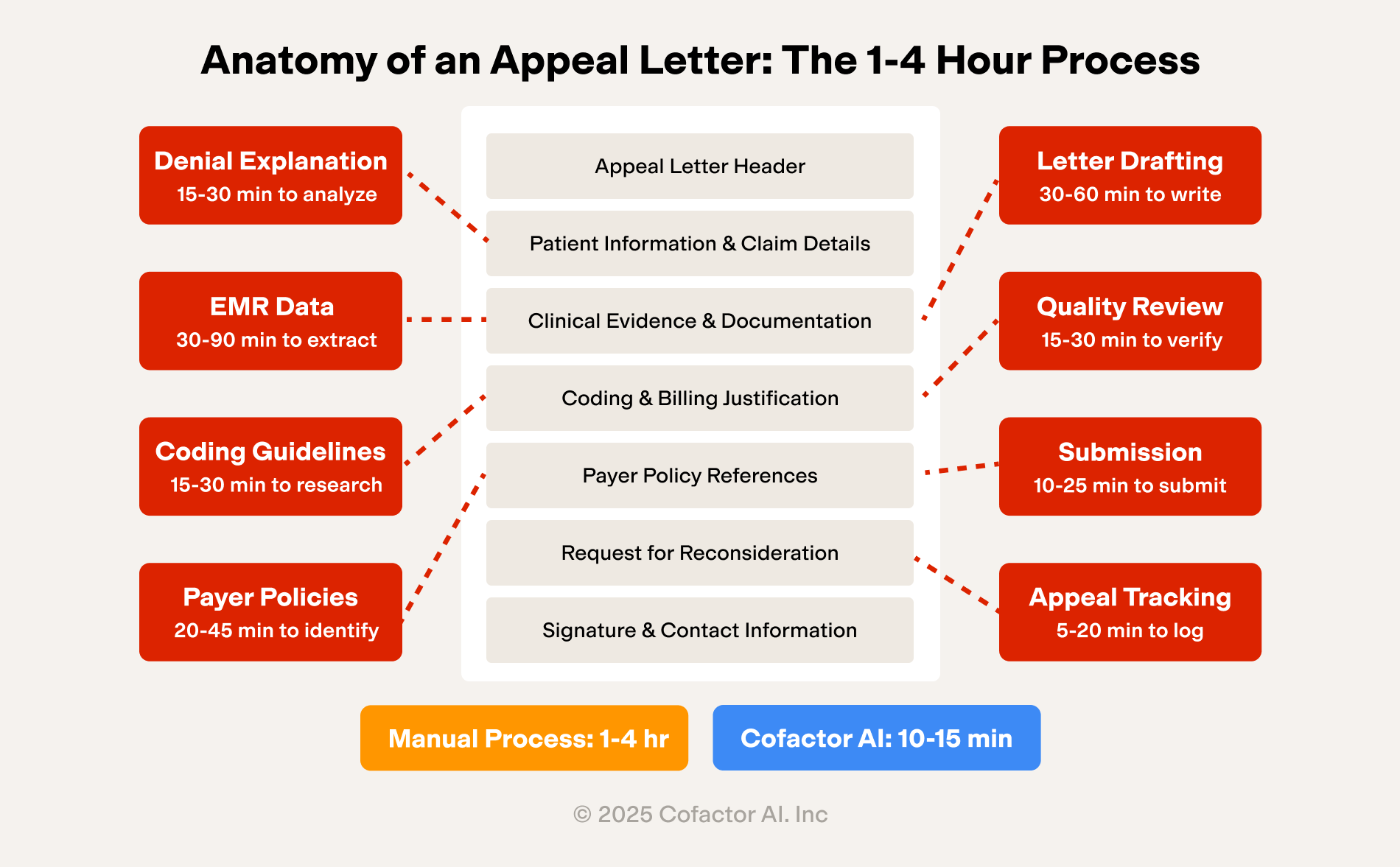
Denials are growing faster than most RCM teams can respond. Payers are scaling AI-powered reviews across evolving policy frameworks. Yet many hospitals are still fighting them manually.
This is beyond being inefficient. It's ultimately unsustainable. When payers can deny in seconds but your team needs days to appeal, you're fighting an uphill battle and leaving revenue on the table.
We analyzed countless successful complex denial overturns across top payers (Aetna, Anthem, UnitedHealthcare, Medical Mutual, CareSource, Molina, The Health Plan, Humana, and others) and distilled down proven patterns, payer-specific nuances, and condition-specific evidence checklists to speed up submission and improve overturn rates while complying with each payer's procedural rules.
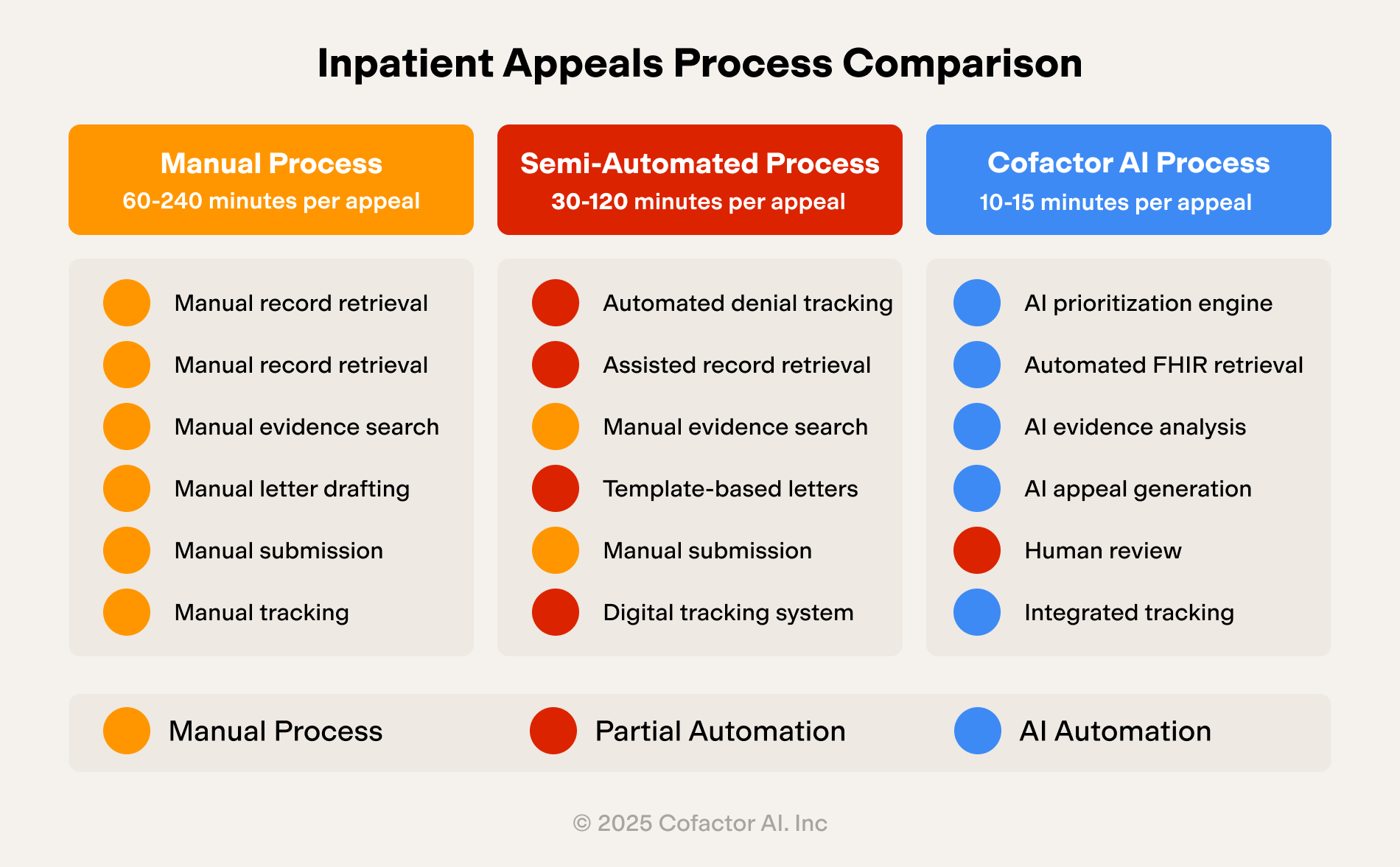
Our automated, policy-aware appeal generation consistently produced outcomes that manual workflows struggle to match. While speed matters, maintaining precision at scale is what drives results. Overturn rates vary significantly based on case selectivity: hospitals that appeal only high-confidence denials with either workflow may see higher baseline rates, while those appealing broader portfolios typically fall within industry averages.
Three Patterns That Win Appeals
- Structure Wins. Reviewers overturned faster when appeals followed a consistent, indexed, hyperlinked format.
- Policy-First Arguments. Mapping denial text to payer policy to chart proof collapsed most denial rationales.
- Data-Driven Documentation. EMR-extracted timestamps and objective data eliminated timing disputes.
The High-Value Targets
Sepsis Downgrades (DRG 871/872/698/720)
These represent significant revenue recovery opportunities. The winning structure pairs the denial rationale verbatim against a policy quote plus chart proof.
Critical Policies: ICD-10-CM I.C.1.d.1.a (A41.9 valid even when cultures negative), I.C.1.d.1.b, Sepsis-3, CMS SEP-1, Surviving Sepsis hour-1 bundle.
Evidence That Wins: SIRS criteria or qSOFA scores, SOFA trends showing organ dysfunction, lactate/procalcitonin values with timestamps, antibiotic timing within the hour-1 bundle, source control documentation with procedure codes.
Key Insight: Payers accept culture-negative sepsis when you can demonstrate SIRS criteria, organ dysfunction scores, and adherence to the sepsis bundle timing. Documentation of the bundle matters as much as the diagnosis itself.
Respiratory Failure & Mechanical Ventilation (J96.01, DRG 637/870)
Critical Policies: ICD-10-CM I.C.10.b.1, Aetna acute respiratory failure thresholds, Berlin ARDS criteria, ATS/ERS guidelines.
Evidence That Wins: ABG strips showing PaO₂ <60 or SpO₂ ≤90%, pulse-ox trend with nadir values, intubation note with ventilator settings (FiO₂, PEEP), ICU admission documentation, critical care time (99291/99292).
Key Insight: The absence of documented gas exchange data is fatal to these appeals. Payers will dismiss clinical impressions of respiratory distress without objective ABG values and ventilator settings. Excludes1 conflicts (like J95.82) don't apply when coded correctly, so cite the specific guideline section.
Principal Diagnosis Sequencing
Common scenarios include rhabdomyolysis vs. COVID-19, SMA dissection/ischemia, and SBO vs. sepsis disputes.
Critical Policies: ICD-10-CM II.A (principal diagnosis definition), II.C (resource-driven sequencing).
Evidence That Wins: Resource consumption charts showing which condition drove care:
- Rhabdomyolysis: IV fluids, strict I&O, daily weights, serial CK monitoring
- SMA dissection: Anticoagulation, serial CTA, ICU monitoring
- SBO: NG decompression/NPO orders, serial exams, imaging follow-through
Key Insight: Payers explicitly accept II.A/II.C arguments when you demonstrate that your selected principal diagnosis consumed the most resources. Chart the actual interventions with timestamps.
MCC/CC Reinstatements
Encephalopathy (G93.41): Requires neuro workup documentation (EEG/LP/CTA), infectious or metabolic etiology, and demonstration of impact on care. Cite ICD-10-CM I.B.14 for multiple coding of acute conditions.
Malnutrition: ASPEN/GLIM criteria require two or more phenotypic plus etiologic criteria, dietitian NFPE with physician co-sign, and proper POA flags.
Suspected Pneumonia MCC: ICD-10-CM Section III and AHA Coding Clinic Q4 2017 allow coding when the condition was evaluated and treated. Culture-negative cases are accepted when you show imaging, leukocytosis, and empiric antibiotics.
Documentation Excellence: Building Your Appeal Foundation
Winning individual denials requires condition-specific clinical knowledge. Winning consistently requires systematic infrastructure. Here's what separates hospitals with high overturn rates from those stuck at industry average:
Proactive Documentation Standards
Early, Explicit POA Flags. Tag conditions as present on admission immediately: sepsis, pneumonia, malnutrition, bacteremia, AKI, encephalopathy. This prevents payers from arguing the condition developed during the stay.
Coder "Code-to-Note" Sheets. Embed these as exhibits in your appeals. Format: ICD-10/CPT to guideline section to chart line/page reference. This lets reviewers trace every code directly to source documentation in seconds.
Physician Addenda. Secure physician confirmation of: sepsis POA and organ dysfunction specifics (SOFA q-points), critical care minutes with life-threatening management tasks, principal diagnosis rationale and resource utilization, MCC impact with specific terminology like "acute metabolic encephalopathy."
Organizational Strength
48-Hour Denial Huddles. Cross-functional teams (clinician, CDI, coder, billing, appeals specialist) complete the Denial to Evidence to Policy cross-walk on Day 1, rather than waiting until day 25 of a 30-day window.
Policy Binder + Guideline Library. Maintain organized access to ICD-10 sections, payer policies, and clinical standards (ASPEN/GLIM, KDIGO, Sepsis-3, ACOG, AHA/ACC, ATS/ERS), searchable and immediately available to appeal writers.
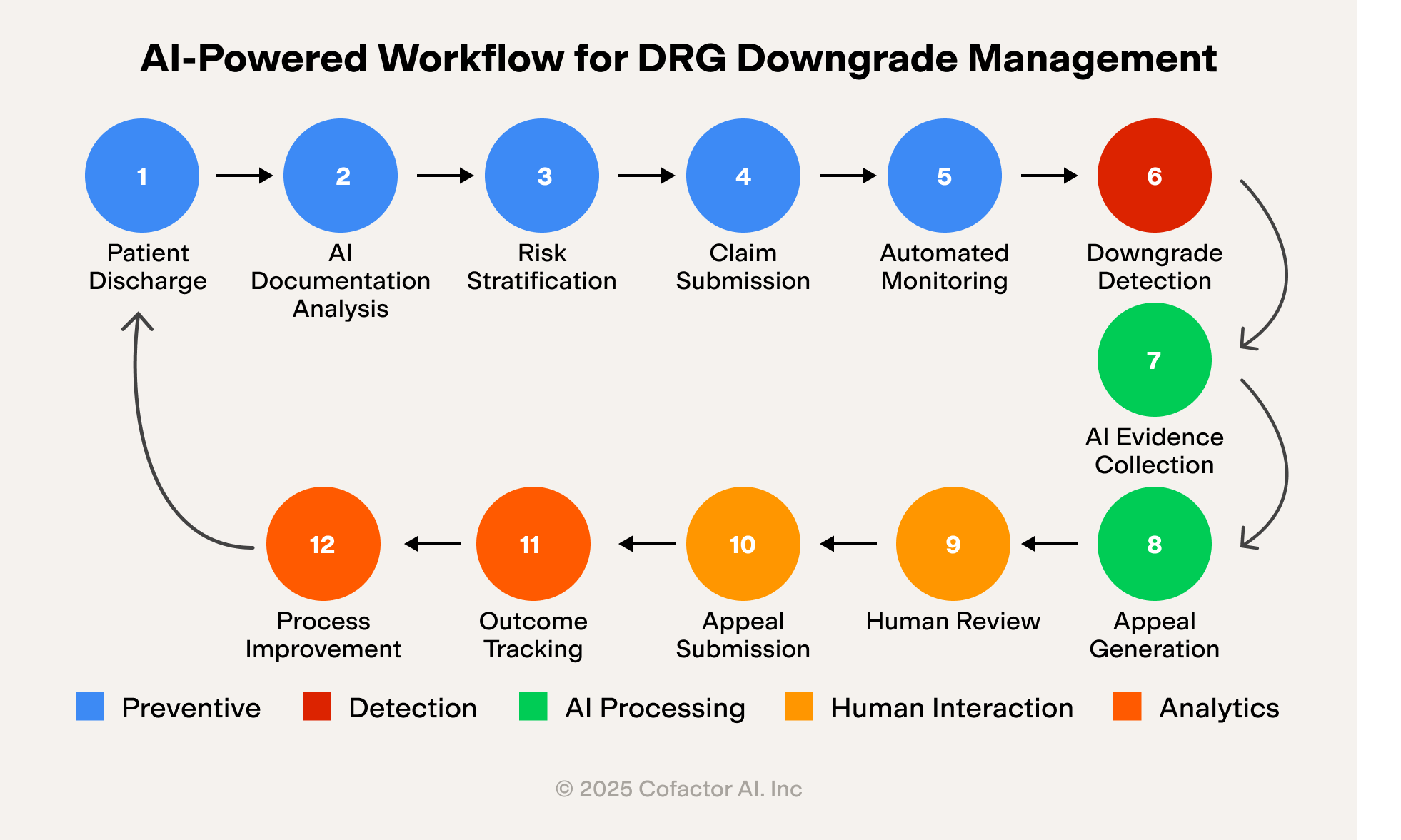
Continuous Post-Appeal Debrief. Log what worked. Update templates. Track trends by denial type, payer, DRG, and days to resolution. Share lessons with CDI, coding, and clinicians in 15-minute huddles.
The full implementation guide includes complete templates for denial huddles, policy binders, exhibit organization, and peer-to-peer one-pagers.
The Payer-Specific Reality
Manual workflows often present evidence and policy separately, forcing reviewers to make the connections themselves. Policy-aware automation instead creates an irrefutable chain of proof: what the chart shows, the policy that defines it, and therefore the code, DRG, or service that should be approved. This explicit linkage eliminates reviewer ambiguity across conditions like sepsis, AKI, malnutrition, and encephalopathy.
From Reactive Appeals to Systematic Defense
Payers have systematized their audit process. It's time hospitals systematize their defense. The appeals that win share common infrastructure:
- Denial-to-Evidence Matrix: Paste denial text verbatim, cite policy, add chart proof, specify remedy
- Coding Cross-Walk: Link ICD/CPT to guideline to chart evidence to DRG impact
- Appeal Cover Letter: Include claim number and DOS in subject, requested action, policy deadline
This isn't about fighting harder. It's about fighting smarter with systems that scale.
Get the Complete Overturn Playbook
This post covers the core patterns. The full Denial Overturn Playbook includes detailed payer-specific strategies with appeal windows and procedural requirements, ready-to-use templates for denial huddles, policy binders, peer-to-peer scripts, and coding cross-walks, and implementation checklists for building systematic appeal infrastructure.
Reach out to learn how Cofactor can automate your appeal generation, standardizing quality and shortening review cycles across all payers.
Systematic approaches win. The question is whether you'll build the system yourself or let us automate it for you.

.svg)